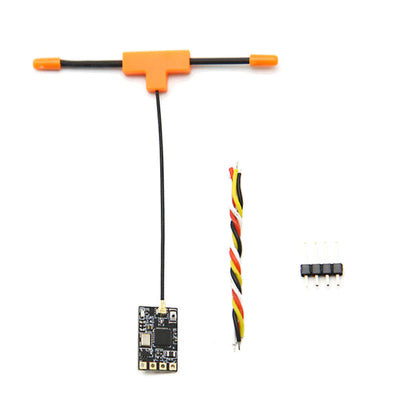
BetaFPV SuperX ELRS Gemini Xross Receiver Nano/Mono Dual-Band 900M+2.4G LR1121 ESP32-C3
BetaFPV SuperX ELRS Gemini Xross Receiver Nano/Mono Dual-Band 900M+2.4G LR1121 ESP32-C3
BETAFPV
Couldn't load pickup availability


Overview
The BetaFPV SuperX ELRS Gemini Xross Receiver is an ExpressLRS receiver based on Semtech LR1121 RF chips and an Espressif ESP32-C3 MCU. It supports 900M (868/915MHz) and 2.4G operation with LoRa and FSK modes (FSK mode up to 1000Hz). Two versions are available: SuperX Nano RX (dual LR1121, Diversity/Gemini, 900M+2.4G) and SuperX Mono RX (single LR1121, single reception, 900M/2.4G band switching).
Key Features
- MCU: ESP32-C3
- RF: Semtech LR1121 (SuperX Mono: single LR1121; SuperX Nano: dual LR1121)
- Modulation: LoRa and FSK (FSK mode up to 1000Hz)
- Gemini modes: 900M Gemini, 2.4G Gemini, and 900M+2.4G Gemini Xrossband (GemX)
- SuperX Nano RX reception mode: Diversity/Gemini; SuperX Mono RX reception mode: Single
- Telemetry power: 20dBm
- Input voltage: 5V
- Serial output protocols: CRSF, SBUS, SUMD, DJI RS2 Pro, MAVLink
- TX module compatibility chart indicates support with Micro / Micro V2 / Nano V2 / SuperG Nano, and Dual-band TX (GemX requires a dual-band TX)
Specifications
| Parameter | SuperX Mono RX | SuperX Nano RX |
|---|---|---|
| MCU | ESP32-C3 | |
| Telemetry Power | 20dBm | |
| Input Voltage | 5V | |
| Protocols | CRSF, SBUS, SUMD, DJI RS2 Pro, MAVLink | |
| RF Chip | Single LR1121 | Dual LR1121 |
| Reception Mode | Single | Diversity/Gemini |
| Frequency Band | 900M/2.4G | 900M+2.4G |
| Antenna Connector | U.FL x1 | U.FL x2 |
| Weight | 0.82g | 1.45g |
| Dimensions | 12.3 x 18.6mm | 16.3 x 21.4mm |
| LUA Name | BFPV SuperX Mon | BFPV SuperX Nan |
| Recommended | 2''- 5'' drones (racing, freestyle, long-range) | 5'' + drones (freestyle, photography, long-range) |
Hardware Labels (from diagrams)
- SuperX Nano RX V1.0 II: ESP32-C3, WiFi Antenna, IPEX MHF I (x2), RGB, GND, 5V, TX, RX, Button, TCXO, 2.4GHz PA, RFSW, LR1121 (x2), SH1.0-4PIN
- SuperX Mono RX V1.0 III: 2.4GHz PA, RFSW, LR1121, TCXO, ESP32-C3, WiFi Antenna, IPEX MHF I, RGB, Button, GND, 5V, TX, RX
Configuration (CRSF example)
- The receiver supports CRSF/SBUS/SUMD (CRSF example shown for Betaflight firmware flight controllers).
- Basic wiring shown: FC TX to RX, FC RX to TX, 5V to 5V, GND to GND.
- JST SH connector pin note: Betaflight pin order is 5V (V+), GND, RX, TX; ExpressLRS pin order is GND, 5V (V+), TX, RX. Check wire sequence when using terminal wires.
- In Betaflight Configurator: enable the UART as Serial Rx in the Ports tab; set Receiver Mode to Serial (via UART) and Serial Receiver Provider to CRSF in the Configuration tab.
For wiring and setup help, contact [email protected].
Bind
The SuperX Receiver uses ExpressLRS V3.x official protocol as its default firmware without a pre-set binding phrase. For operation, the transmitter module should use ExpressLRS V3.x (or later) firmware with no pre-set binding phrase.
- Power-cycle the receiver 3 times with a 1-second interval, or press and hold the BOOT button for 2 seconds to enter binding mode.
- The RGB indicator flashes orange twice to indicate bind mode.
- Bind from the transmitter module. A solid RGB indicator indicates the receiver is bound.
- After binding once, the receiver remembers the autosaved binding phrase and device for automatic binding on restart.
- If firmware is flashed and a binding phrase is set, set the same binding phrase on the transmitter module for automatic binding.
- Recommendation: place two antennas as far apart as possible for better reception.
Notes (GPS interference guidance)
To minimize GPS interference when using 868MHz, X150, or LowBand packet rates, avoid setting the telemetry ratio to 1:2 unless necessary (especially at 100mW telemetry power). If MAVLink or a 1:2 telemetry ratio is required, position the receiver as far as possible from the GPS and avoid pointing the receiver antenna toward the GPS during satellite acquisition.
What’s Included
Item: SuperX ELRS Gemini Xross Receiver - Nano
- 1* SuperX Nano Receiver
- 2* Dual-band T Antenna
- 1* SH1.0 Connector (Double Ended)
- 2* Heat Shrink Tubing
- 1* User Manual
Item: SuperX ELRS Gemini Xross Receiver - Mono
- 1* SuperX Mono Receiver
- 1* Dual-band T Antenna
- 1* SH1.0 Connector (Single Ended)
- 2* Heat Shrink Tubing
- 1* User Manual
Applications
- Racing, freestyle, long-range
- Photography
Manuals & Firmware
- User Manual
- Firmware for SuperX ELRS Gemini Xross Receiver
- How to flash the firmware of SuperX Receiver via Passthrough or WIFI?
- ExpressLRS Gemini documentation
- ExpressLRS on GitHub
Details

SuperX brings dual-band ExpressLRS performance with LoRa and FSK modes, built around the ESP32‑C3 and Semtech LR1121 RF platform.

SuperX Nano RX uses dual LR1121 chips with two U.FL (IPEX MHF I) antenna connectors for Diversity/Gemini operation.

SuperX Mono RX keeps the build simple with a single LR1121 and one U.FL antenna connector, supporting 900M/2.4G band switching.

Choose the reception method that fits your build—single antenna, diversity, or Gemini for improved link robustness.

Gemini Xrossband (GemX) enables simultaneous 900MHz + 2.4GHz operation when paired with a compatible dual-band transmitter.

Dual-band 900M+2.4G is designed for reliability across freestyle, cinematic, and long-range flying.

For micro builds, quick band switching helps balance range and latency based on where you fly.

Check the chart to match SuperX Mono or SuperX Nano with your ELRS TX module; GemX requires a dual-band transmitter.

Packet rates and modulation support vary by chip type and band—use this reference when selecting your link settings.

SuperX sits in the ExpressLRS receiver lineup as the dual-band Gemini-capable option.

Standard CRSF wiring uses TX↔RX, plus 5V and GND, for a clean serial receiver install.

Confirm the JST-SH pin order before plugging in terminal leads, since Betaflight and ExpressLRS wire sequences can differ.

Enable Serial RX on the chosen UART in Betaflight Ports to start receiver configuration.

Set Receiver Mode to Serial (via UART) and select CRSF as the serial receiver provider.

ExpressLRS V3.x firmware support keeps binding and setup consistent with modern ELRS tools.

Everything needed for installation is included, including the antenna, leads, and SuperX receiver user manual.