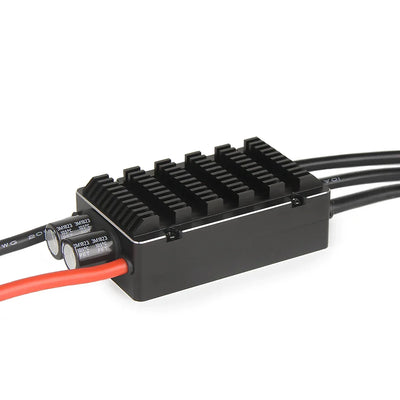
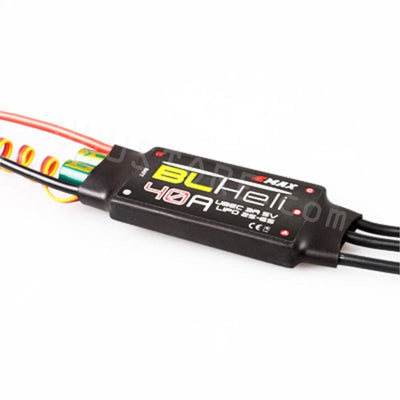
T-Motor AT20A Electronic Speed Controller (ESC) 20A, 2-3S LiPo, 5V/2A Linear BEC
T-Motor AT20A Electronic Speed Controller (ESC) 20A, 2-3S LiPo, 5V/2A Linear BEC
T-MOTOR
Couldn't load pickup availability


Overview
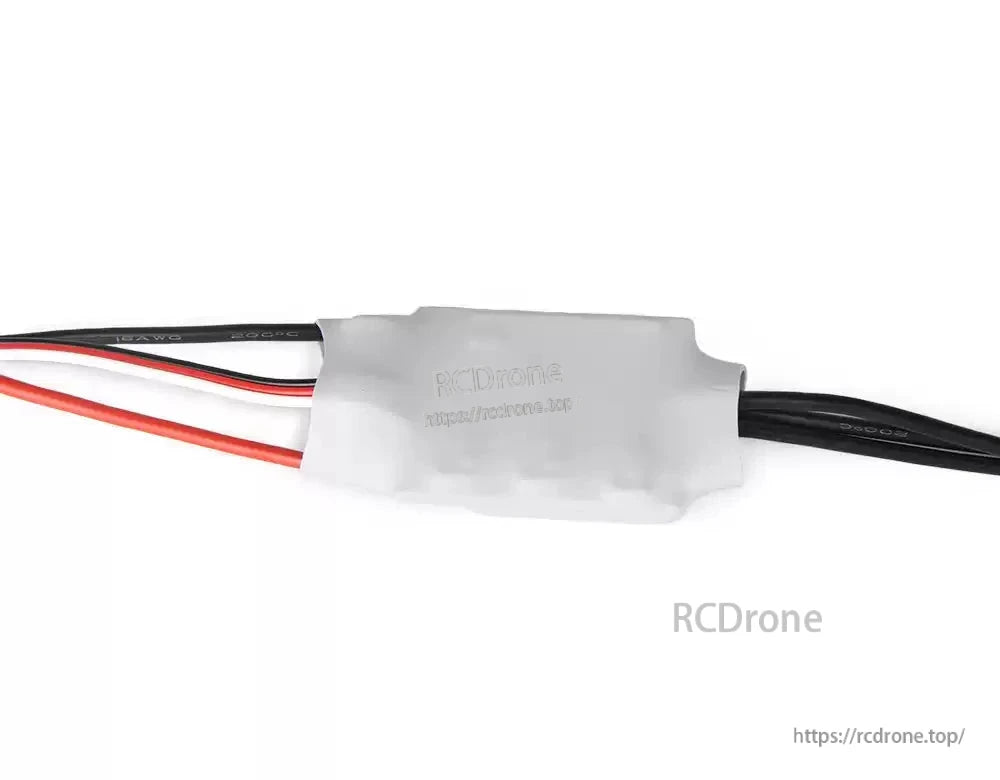
Product type: Electronic Speed Controller (ESC). The T-Motor AT20A is a fixed-wing ESC that supports 2-3S LiPo batteries and includes an integrated 5V linear BEC (up to 2A) designed to power the receiver and servos. It supports functions such as voltage protection, thermal protection, failsafe, brake, soft start, and more. The AT20A ESC uses a JST connector for battery connection.
Key Features
- Fixed-wing ESC; support 2-3S battery
- Excellent performance, reliable quality
- High speed throttle response
- Multiple programmable parameters; supports LED programming card parameter setting
- Hardware filtering and synchronous continued current function for faster, more reliable throttle control
- Multiple protection functions include abnormal voltage, ESC thermal, battery low-voltage, throttle signal loss
For product compatibility questions and after-sales support, contact [email protected] or visit https://rcdrone.top/.
Specifications
AT20A (as shown on product label and manual table)
| Model | AT-20A |
| Continuous current | 20A |
| Burst current (≤10s) | 25A |
| BEC mode | Linear |
| BEC output | 5V/2A |
| Battery (LiPo) | 2-3S |
| Battery (NiMH) | 5-9 cells |
| BEC output capability (2S LiPo) | 5 servos |
| BEC output capability (3S LiPo) | 4 servos |
| Weight | 19g |
| Size (L*W*H) | 42*25*8 |
| Battery connector | JST |
| Label marking | 2-3S LiPo; BEC 2A@5V |
Motor speed (from AT Fixed Wing Series ESC manual)
- The highest speed can reach 210,000 RPM (2-pole motor), 70,000 RPM (6-pole motor), 35,000 RPM (12-pole motor).
Programmable parameters (tone selection table shown)
| Item | "beep" (1 short tone) | "beep-beep" (2 short tones) | "beep-beep-beep" (3 short tones) |
| Brake | Off | On | |
| Battery type | Lipo | NiMH | |
| Cutoff mode | Soft-Cut | Cut-Off | |
| Cutoff threshold | Low | Medium | High |
| Start mode | Normal | Soft | Super soft |
| Timing | Low | Medium | High |
Manual values shown for startup and timing
- Startup Mode: Normal/Soft/Super-Soft; motor speed time from stationary to maximum is 300ms / 1.5s / 3s.
- Timing: Low/Medium/High (3.75°/15°/26.25°).
AT Fixed Wing Series ESC specifications table (visible in manual image; for reference)
| Model | Cont current | Burst current (≤10s) | BEC mode | BEC output |
| AT-20A | 20A | 25A | Linear | 5V/2A |
| AT-30A | 30A | 40A | Linear | 5V/2A |
| AT-40A-UBEC | 40A | 55A | Switch | 5V/3A |
| AT-55A-UBEC | 55A | 75A | Switch | 5V/5A |
| AT-75A-UBEC | 75A | 95A | Switch | 5V/5A |
| AT-115A-UBEC | 115A | 120A | Switch | 5.2V/6V/7.4V; 10A/25A |
BEC output capability / battery / size table (visible in manual image; for reference)
| BEC output capability | 2S LiPo | 3S LiPo | 4S LiPo | 6S LiPo | Battery cell (LiPo) | Battery cell (NiMH) | Weight | Size (L*W*H) |
| 5 servos | 4 servos | 2-3S | 5-9 cells | 19g | 42*25*8 | |||
| 5 servos | 4 servos | 2-3S | 5-9 cells | 37g | 68*25*8 | |||
| 5 servos | 5 servos | 5 servos | 2-4S | 5-12 cells | 43g | 65*25*12 | ||
| 8 servos | 8 servos | 6 servos | 6 servos | 2-6S | 5-18 cells | 63g | 77*35*14 | |
| 8 servos | 8 servos | 6 servos | 6 servos | 2-6S | 5-18 cells | 82g | 86*38*12 | |
| 8 servos | 8 servos | 6 servos | 6 servos | 6-14S | 18-42 cells | 182g | 92*46*27.3 |
Applications
- Compatible with fixed-wing aircraft and helicopter (as stated in the AT Fixed Wing Series ESC manual)
Manuals
Low-voltage threshold values shown (manual text)
- When the battery type is set to Lipo battery, the battery cell number can be judged by ESC automatically.
- Low / medium / high cutoff voltage for each cell is: 2.85V / 3.15V / 3.3V.
- Example: For a 3S Lipo, when "Medium" cutoff threshold is set, the cut-off voltage will be: 3.15*3=9.45V.
- When the battery type is set to a NiMH battery, low / medium / high cutoff voltages are 0%/50%/65% of the startup voltage, and 0% means the low voltage cut-off function is disabled.
- Example: For a 6 cells NiMH battery, fully charged voltage is 1.44*6=8.64V, when "Medium" cut-off threshold is set, the cut-off voltage will be: 8.64*50%=4.32V.
Throttle range calibration (manual flow chart text)
- Switch on the transmitter, move the throttle stick to the top position.
- Connect battery pack to the ESC, and wait for about 2 seconds.
- The "Beep-Beep-" tone should be emitted, means the top point of throttle range has been confirmed.
- Move throttle stick to the bottom position, and wait for 1 second.
- A long "Beep--" tone should be emitted, means Lipo battery cell number.
- The "Beep-Beep-" tone means the bottom point of the throttle range has been confirmed.
Normal startup procedure (manual flow chart text)
- Move throttle stick to bottom position and then switch on transmitter.
- Connect battery pack to ESC, special tone like "123" means power supply is OK.
- Several "beep-" tones should be emitted to present the amount of lithium battery cells number.
- When self-test is finished, a long "beep-----" tone should be emitted.
- Move throttle stick upwards to go flying.
Protection functions (manual text)
- Start up protection: If the motor fails to start up within 2 seconds when pushing the throttle, the ESC will cut-off the output power. In this case, the throttle stick MUST be moved to the bottom again to restart the motor.
- Temperature protection: When the temperature of the ESC is over about 110 Celsius degrees, the ESC will reduce the output power.
- Throttle signal loss protection: The ESC will reduce the output power if throttle signal is lost for 1 second; further loss for 2 seconds will cause the output to be cut-off completely.
- Overload protection: When the load suddenly becomes very large, the power will be cut off or restarted automatically.
Trouble shooting (manual table text)
| Trouble | Possible reason | Action |
| After power on, motor does not work, no sound is emitted | battery pack and ESC is not correct | Check the power connection. Replace the connector. |
| After power on, motor does not work, such an alert tone is emitted: "beep-beep-, beep-beep-, beep-beep-" (Every "beep-beep-" has a time interval of about 1 second) | The battery pack and Input voltage is abnormal, too high or too low. | Check the voltage of battery pack |
| After power on, motor does not work, such an alert tone is emitted: "beep-, beep-, beep-" (Every "beep-" has a time interval of about 2 seconds) | Throttle signal is irregular | Check the receiver and transmitter. Check the cable of throttle channel |
| After power on, motor does not work, such an alert tone is emitted: "beep-, beep-, beep-" (Every "beep-" has a time interval of about 0.25 second) | The throttle stick is not in the bottom (lowest) position | Move the throttle stick to bottom position. Reset the throttle range |
| After power on, motor does not work, a special tone "56712" is emitted after 2 beep tone (beep-beep-) | Direction of the throttle channel is reversed, so the ESC has entered the program mode | Set the direction of throttle channel correctly |
| The motor runs in the opposite direction | Errors in the sequence of the connection between the output line and the motor line. | Align any two switches in the three output lines. |
Programming with transmitter (manual text)
- Program the ESC with your transmitter (4 Steps): 1. Enter program mode 2. Select programmable items 3. Set parameter value (Programmable value) 4. Exit program mode
- Note: Please make sure the throttle curve is set to 0 when the throttle stick is at bottom position and 100% for the top position.
Enter program mode (manual text)
- Switch on transmitter, move throttle stick to top position, connect the battery to ESC.
- Wait for 2 seconds, the motor should emit special tone like "beep-beep-".
- Wait for another 5 seconds, special tone like "56712" should be emitted, which means program mode is entered.
Select programmable items (manual text)
- After entering program mode, you will hear 8 tones in a loop with the following sequence. If you move the throttle stick to bottom within 3 seconds after one kind of tones, this item will be selected.
- 1. "beep" brake (1 short tone)
- 2. "beep-beep" battery type (2 short tone)
- 3. "beep-beep-beep" cutoff mode (3 short tone)
- 4. "beep-beep-beep-beep" cutoff threshold (4 short tone)
- 5. "beep-----" startup mode (1 long tone)
- 6. "beep-----beep-" timing (1 long 1 short)
- 7. "beep-----beep-beep-" set all to default (1 long 2 short)
- 8. "beep-----beep-----" exit (2 long tone)
- Note: 1 long "beep-----" = 5 short "beep-". So in "Select Settings," a long and short "beep-beep" means the 6th option, and so on.
Set item value / Exit program mode (manual text)
- Set the value matching to a tone by moving throttle stick to top when you hear the tone, then a special tone "1515" emits, means the value is set and saved.
- Keeping the throttle stick at top will return to Step 2 and you can select other items; moving the stick to bottom within 2 seconds will exit program mode directly.
- There are 2 ways to exit program mode: (1) In step 3, after special tone "1515", move throttle stick to the bottom position within 2 seconds. (2) In step 2, after tone "beep-----beep-----" (that is: The item #8), move the throttle stick to bottom within 3 seconds.
Details
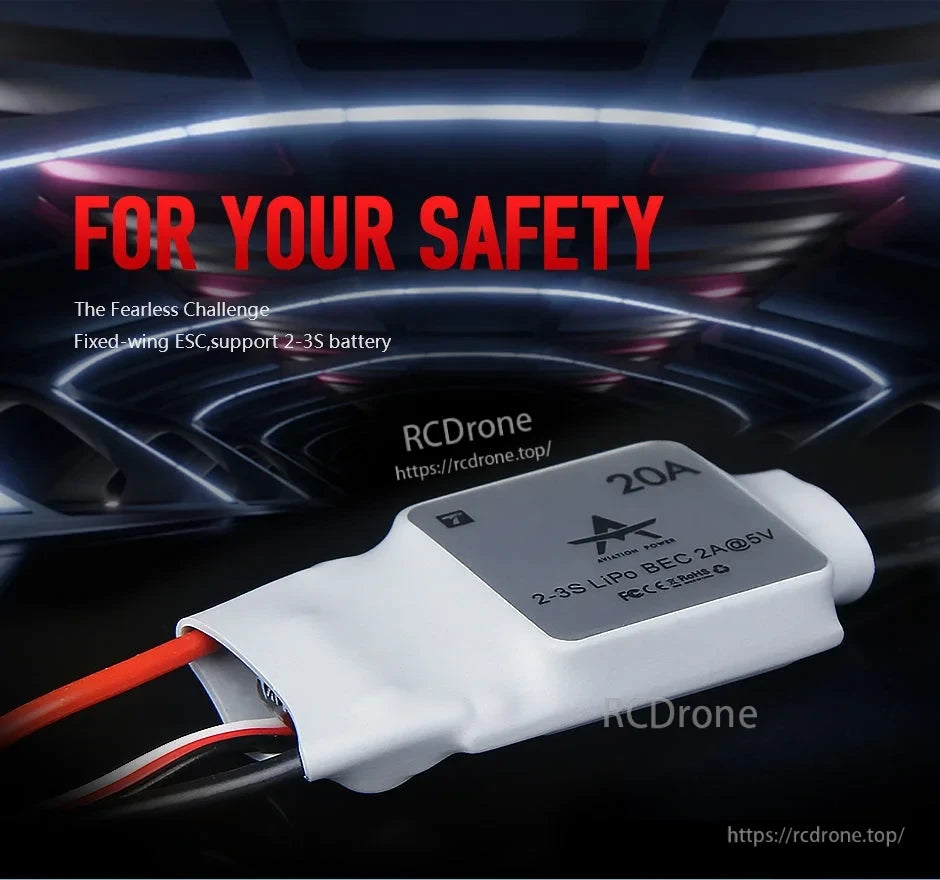
The AT20A 20A fixed-wing ESC is labeled for 2–3S LiPo use and includes a 5V 2A BEC for onboard power.

T-Motor AT series ESCs are described as using a dedicated fixed-wing control algorithm and an optimized software structure for motor control.

T-Motor AT20A ESC marketing highlights include high-speed throttle response and multiple protection functions such as low-voltage and throttle-signal loss.
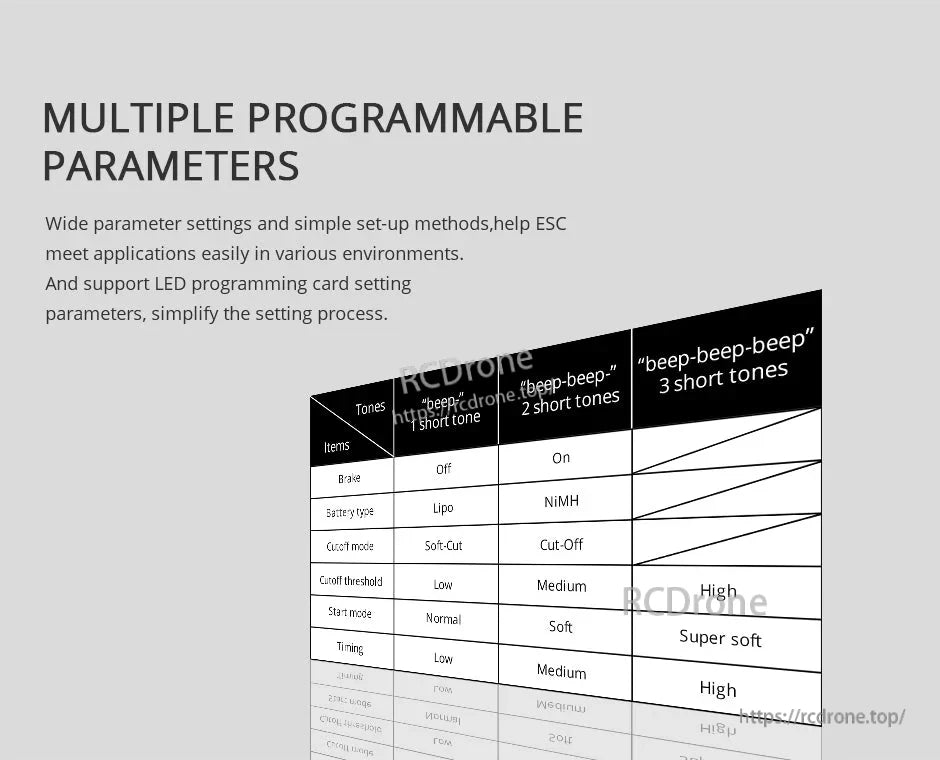
The AT20A ESC supports multiple programmable settings via beep tones, including brake on/off, LiPo/NiMH selection, cutoff options, start mode, and timing.
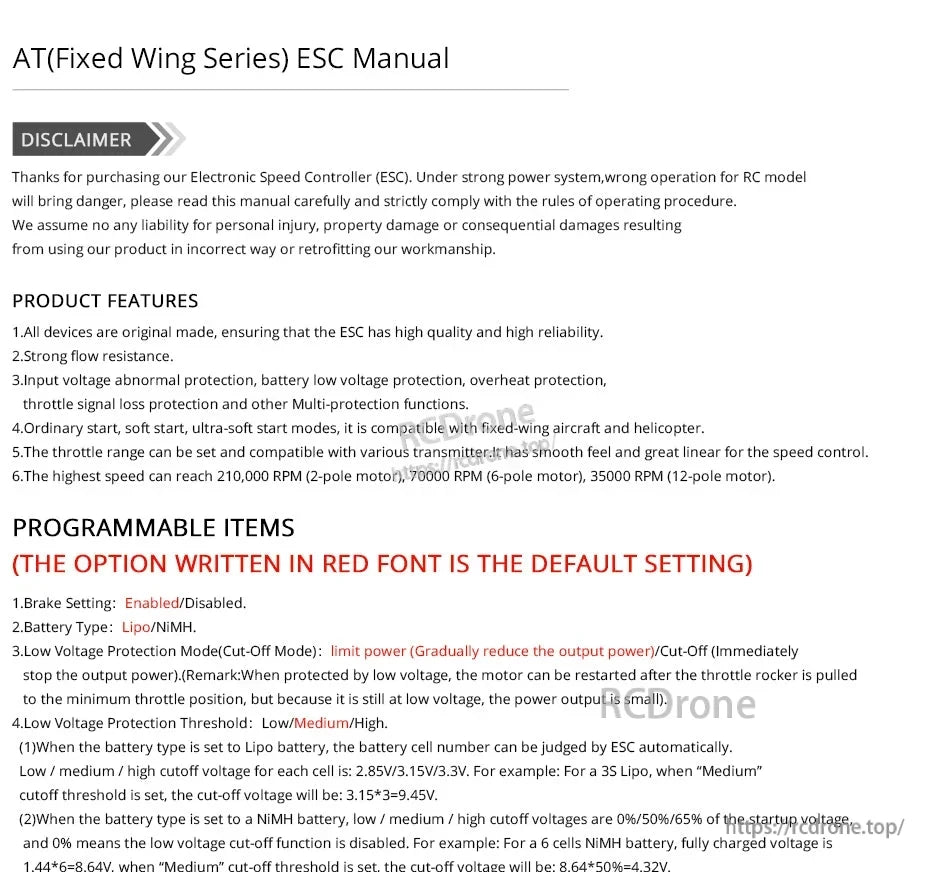
The AT series ESC manual outlines key features and programmable options such as brake setting, battery type (LiPo/NiMH), and low-voltage protection modes.
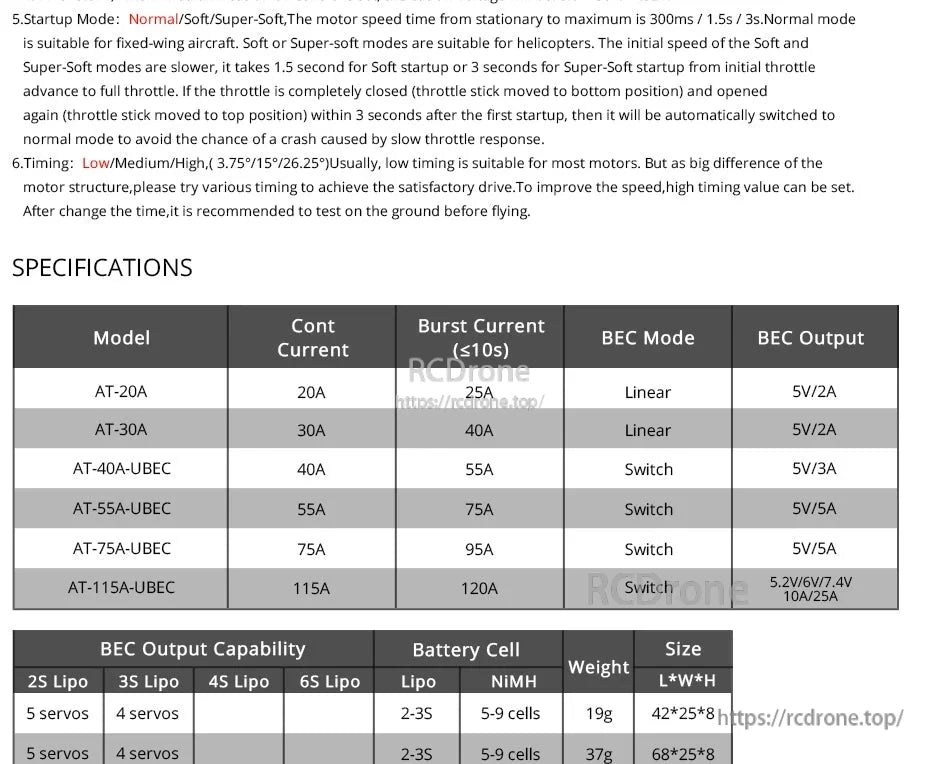
The T-Motor AT-20A ESC is rated for 20A continuous current with 25A burst (≤10s) and includes a 5V/2A linear BEC output.
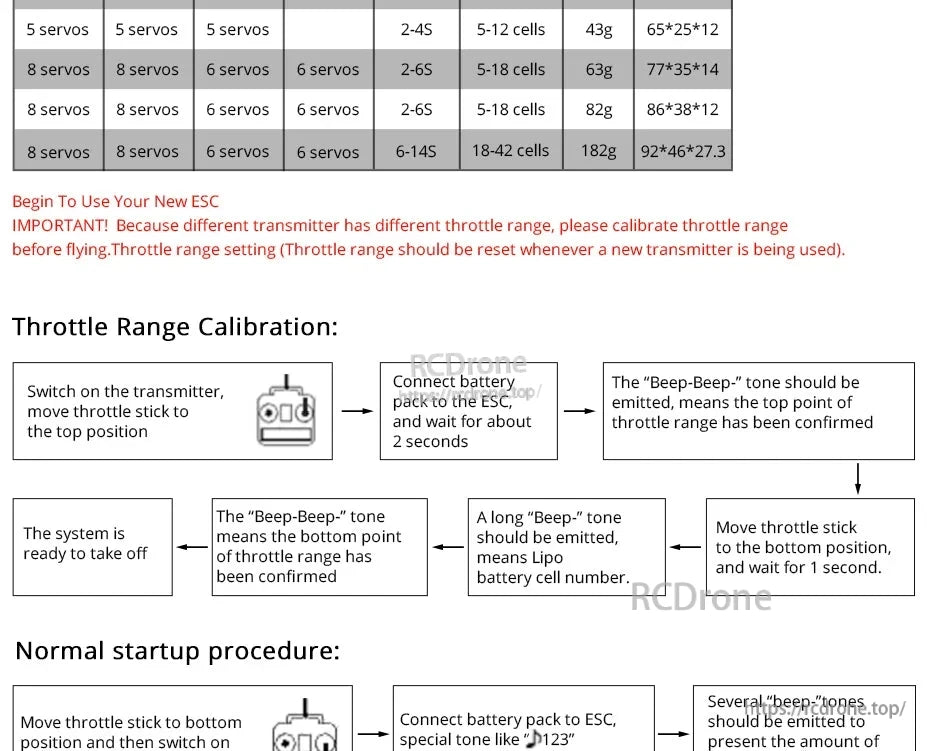
The T-Motor AT20A ESC includes a step-by-step throttle range calibration and startup sequence with beep-tone prompts for setup.
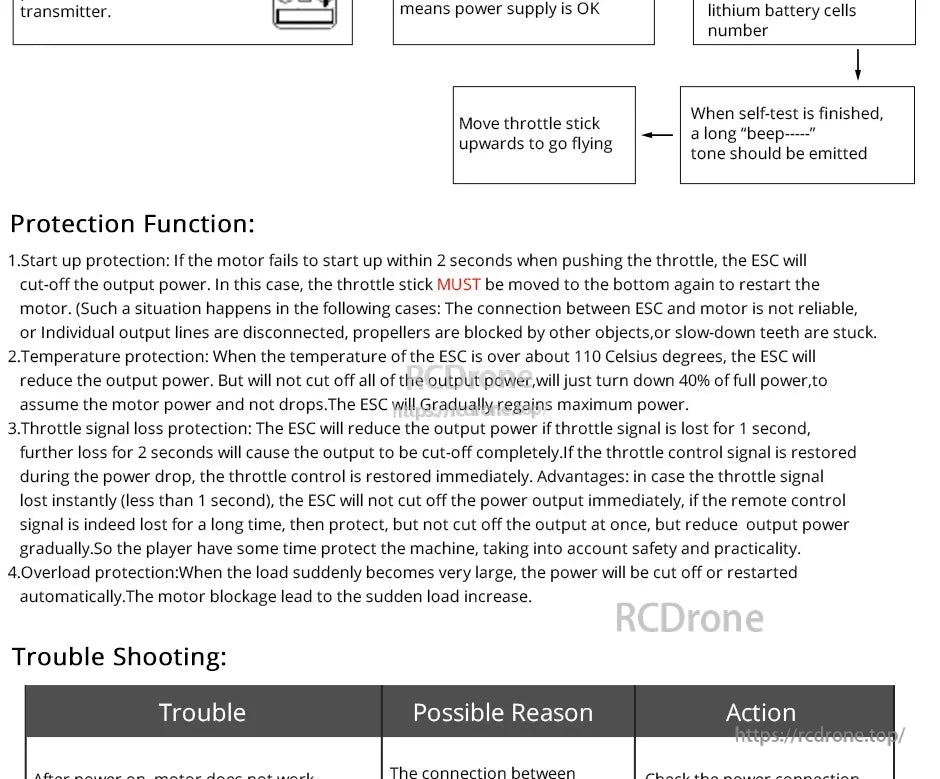
The T-Motor AT20A ESC documentation outlines startup, temperature (about 110°C), throttle-signal loss, and overload protection along with basic troubleshooting steps.
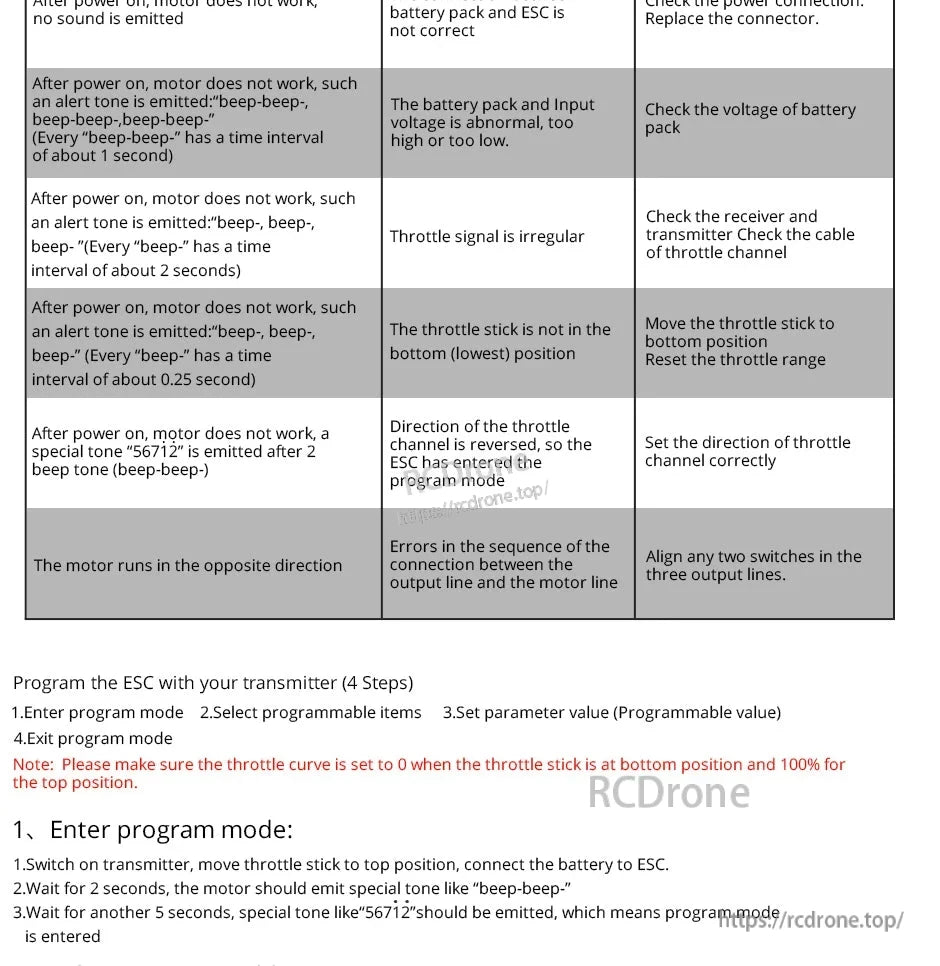
The AT20A ESC guide outlines common beep-code alerts, basic checks, and four-step transmitter programming for setup.
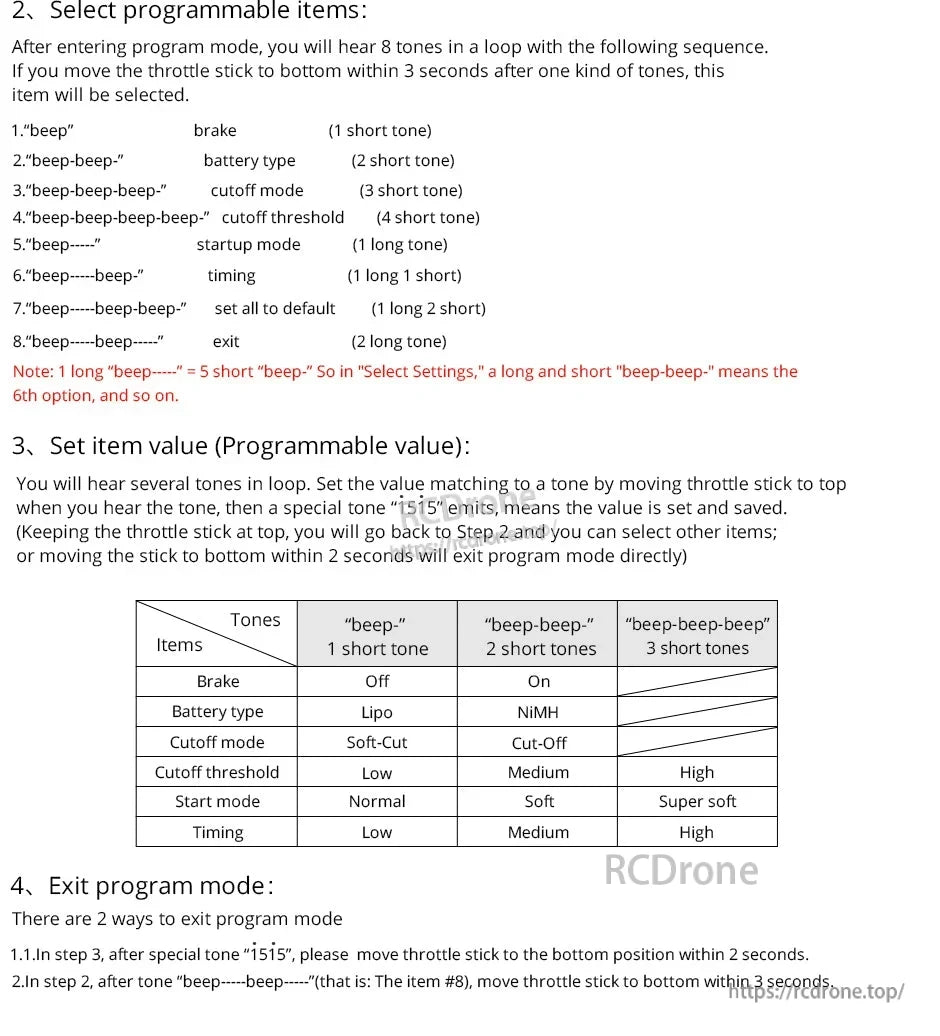
The AT20A ESC uses a beep-tone programming menu to set brake, battery type, cutoff behavior, startup mode, and timing options.