


T-Motor AT55A-UBEC 55A Fixed Wing ESC for Outdoor Aircraft, 2-6S LiPo, 5V/5A BEC, Programmable
T-Motor AT55A-UBEC 55A Fixed Wing ESC for Outdoor Aircraft, 2-6S LiPo, 5V/5A BEC, Programmable
T-MOTOR
Couldn't load pickup availability


Overview
The T-Motor AT55A is a Fixed Wing ESC for outdoor aircraft. It supports 2-6S LiPo power input and features an integrated 5V SBEC rated up to 5A. The ESC supports voltage protection, thermal protection, failsafe, brake, and soft start functions. Note: AT55A ESC does not have a connector for connecting a battery.
Key Features
- Fixed-wing ESC; supports 2-6S battery (as shown)
- Integrated UBEC/SBEC: 5V output, up to 5A (as shown and stated)
- High-speed throttle response (as shown)
- Multiple programmable parameters; supports LED programming card parameter setting (as shown)
- Protections mentioned across product text/manual pages: input voltage abnormal protection, battery low-voltage protection, overheat/thermal protection, throttle signal loss protection
For customer service and technical support, contact https://rcdrone.top/ or email [email protected].
Specifications
AT-55A-UBEC (from the specification table shown)
| Model | AT-55A-UBEC |
| Cont Current | 55A |
| Burst Current (≤10s) | 75A |
| BEC Mode | Switch |
| BEC Output | 5V/5A |
| Battery Cell (LiPo) | 2-6S |
| Battery Cell (NiMH) | 5-18 cells |
| BEC Output Capability | 2S LiPo: 8 servos; 3S LiPo: 8 servos; 4S LiPo: 6 servos; 6S LiPo: 6 servos |
| Weight | 63g |
| Size (L*W*H) | 77*35*14 |
| Battery Connector | Not included (no connector for connecting a battery) |
Applications
- Outdoor fixed-wing aircraft power systems (as stated)
Manuals
Manual notes (as shown)
- Under a strong power system, incorrect operation may cause risk; read the manual carefully and follow the operating procedure.
- The manual states no responsibility for issues resulting from incorrect use or modification.
Product Features (from the manual page shown)
- All devices are original made, ensuring that the ESC has high quality and high reliability.
- Strong flow resistance.
- Input voltage abnormal protection, battery low voltage protection, overheat protection, throttle signal loss protection, and other multi-protection functions.
- Ordinary start, soft start, ultra-soft start modes; compatible with fixed-wing aircraft and helicopter (as written in the manual).
- Throttle range can be set and compatible with various transmitter; smooth feel and good linearity for speed control.
- Highest speed can reach 210,000 RPM (2-pole motor), 70,000 RPM (6-pole motor), 35,000 RPM (12-pole motor).
Programmable Items (manual)
Note shown in the manual: the option written in red font is the default setting.
- Brake Setting: Enabled/Disabled.
- Battery Type: Lipo/NiMH.
- Low Voltage Protection Mode (Cut-Off Mode): limit power (Gradually reduce the output power) / Cut-Off (Immediately stop the output power).
Remark shown: When protected by low voltage, the motor can be restarted after the throttle rocker is pulled to the minimum throttle position; however, because it is still at low voltage, the power output is small. - Low Voltage Protection Threshold: Low/Medium/High.
- When battery type is set to Lipo, the battery cell number can be judged by ESC automatically. Low/medium/high cutoff voltage for each cell is: 2.85V/3.15V/3.3V. Example shown: for a 3S Lipo with “Medium” threshold, cutoff voltage is 3.15*3=9.45V.
- When battery type is set to a NiMH battery, low/medium/high cutoff voltages are 0%/50%/65% of the startup voltage; 0% means the low voltage cut-off function is disabled. Example shown: for 6 cells NiMH, fully charged voltage is 1.44*6=8.64V; when “Medium” threshold is set, the cutoff voltage is 8.64*50%=4.32V.
- Startup Mode: Normal/Soft/Super-Soft. The motor speed time from stationary to maximum is 300ms / 1.5s / 3s.
- Normal mode is suitable for fixed-wing aircraft.
- Soft or Super-soft modes are suitable for helicopters.
- Manual note shown: if throttle is completely closed and opened again (throttle stick moved to top position) within 3 seconds after the first start, it will be automatically switched to normal mode to avoid slow throttle response.
- Timing: Low/Medium/High (3.75°/15°/26.25°). Manual note: usually, low timing is suitable for most motors; after changing timing, test on the ground before flying.
Protection Function (manual)
- Start up protection: if the motor fails to start up within 2 seconds when pushing the throttle, the ESC will cut-off the output power. In this case, the throttle stick must be moved to the bottom again to restart the motor. Cases listed: connection between ESC and motor is not reliable; output lines are disconnected; propellers are blocked by other objects; or slow-down teeth are stuck.
- Temperature protection: when the temperature of the ESC is over about 110 Celsius degrees, the ESC will reduce the output power. It will not cut off all output power; it will turn down 40% of full power so the motor power does not drop, and then gradually regains maximum power.
- Throttle signal loss protection: the ESC will reduce output power if throttle signal is lost for 1 second; further loss for 2 seconds will cause output power to be cut off completely. If the throttle control signal is restored during the power drop, the throttle control is restored immediately. Manual note: if the remote control signal is lost for a long time, the ESC reduces power gradually rather than cutting off output at once.
- Overload protection: when the load suddenly becomes very large, the power will be cut off or restarted automatically. The motor blockage can lead to sudden load increase.
Throttle Range Calibration (manual)
- Switch on the transmitter; move the throttle stick to the top position.
- Connect the battery pack to the ESC; wait for about 2 seconds.
- The “Beep-Beep-” tone should be emitted, which means the top point of throttle range has been confirmed.
- Move the throttle stick to the bottom position and wait for 1 second.
- The “Beep-Beep-” tone means the bottom point of the throttle range has been confirmed.
- A long “Beep” tone should be emitted, which means LiPo battery cell number.
- The system is ready for flight.
Normal Startup Procedure (manual)
- Move throttle stick to bottom position and then switch on transmitter.
- Connect battery pack to ESC; special tone like “123” means power supply is OK.
- Several “beep-” tones should be emitted to present the amount of lithium battery cells number.
- When self-test is finished, a long “beep-----” tone should be emitted.
- Move throttle stick upwards to fly.
Trouble Shooting (manual table shown)
- After power on, motor does not work, and no sound is emitted: Possible reason: connection between battery pack and ESC is not correct. Action: check the power connection; replace the connector.
- After power on, motor does not work, alert tone “beep-beep-, beep-beep-, beep-beep-” (each “beep-beep-” interval about 1 second): Possible reason: battery pack and input voltage is abnormal, too high or too low. Action: check the voltage of battery pack.
- After power on, motor does not work, alert tone “beep-, beep-, beep-” (each “beep-” interval about 2 seconds): Possible reason: throttle signal is irregular. Action: check the receiver and transmitter; check the cable of throttle channel.
- After power on, motor does not work, alert tone “beep-, beep-, beep-” (each “beep-” interval about 0.25 second): Possible reason: throttle stick is not in the bottom (lowest) position. Action: move the throttle stick to bottom position; reset the throttle range.
- After power on, motor does not work, special tone “56712” is emitted after 2 beep tone (beep-beep-): Possible reason: direction of the throttle channel is reversed, so the ESC has entered program mode. Action: set the direction of throttle channel correctly.
- The motor runs in the opposite direction: Possible reason: errors in the sequence of the connection between the output line and the motor line. Action: swap any two of the three output lines.
Programming With Transmitter (4 steps, manual)
- Enter program mode
- Select programmable items
- Set parameter value (programmable value)
- Exit program mode
Manual note shown: make sure the throttle curve is set to 0 when the throttle stick is at bottom position and 100% for the top position.
1) Enter Program Mode (manual)
- Switch on transmitter; move throttle stick to top position; connect the battery to ESC.
- Wait for 2 seconds; the motor should emit a special tone like “beep-beep-”.
- Wait for another 5 seconds; special tone like “56712” should be emitted, which means program mode is entered.
2) Select Programmable Items (manual)
After entering program mode, 8 tones are played in a loop. If the throttle stick is moved to bottom within 3 seconds after one kind of tone, that item is selected:
- 1. “beep” (1 short tone): brake
- 2. “beep-beep-” (2 short tone): battery type
- 3. “beep-beep-beep-” (3 short tone): cutoff mode
- 4. “beep-beep-beep-beep-” (4 short tone): cutoff threshold
- 5. “beep-----” (1 long tone): startup mode
- 6. “beep-----beep-” (1 long 1 short): timing
- 7. “beep-----beep-beep-” (1 long 2 short): set all to default
- 8. “beep-----beep-----” (2 long tone): exit
Manual note shown: 1 long “beep-----” equals 5 short “beep-”.
3) Set Item Value (Programmable Value) (manual)
Tones are played in a loop. Set the value matching a tone by moving the throttle stick to top when the tone is heard. A special tone “1515” indicates the value is set and saved. Keeping the throttle stick at top returns to item selection; moving the stick to bottom within 2 seconds exits program mode directly.
| Tones / Items | “beep-” (1 short tone) | “beep-beep-” (2 short tones) | “beep-beep-beep-” (3 short tones) |
| Brake | Off | On | |
| Battery type | Lipo | NiMH | |
| Cutoff mode | Soft-Cut | Cut-Off | |
| Cutoff threshold | Low | Medium | High |
| Start mode | Normal | Soft | Super soft |
| Timing | Low | Medium | High |
4) Exit Program Mode (manual)
Two ways are shown:
- In step 3, after special tone “1515”, move throttle stick to bottom position within 2 seconds.
- In step 2, after tone “beep-----beep-----” (item #8), move throttle stick to bottom within 3 seconds.
Details

The T-Motor AT55A-UBEC fixed-wing ESC is labeled for 2–6S LiPo use and includes a 5A/5V UBEC for powering onboard electronics.

The AT series ESC is described with a dedicated fixed-wing core algorithm program and an optimized software structure for motor control.
The AT55A-UBEC ESC supports BEC output to provide stable power delivery in different power supply environments.

The AT55A-UBEC ESC emphasizes fast throttle response with protection functions such as low-voltage and throttle signal loss safeguards.
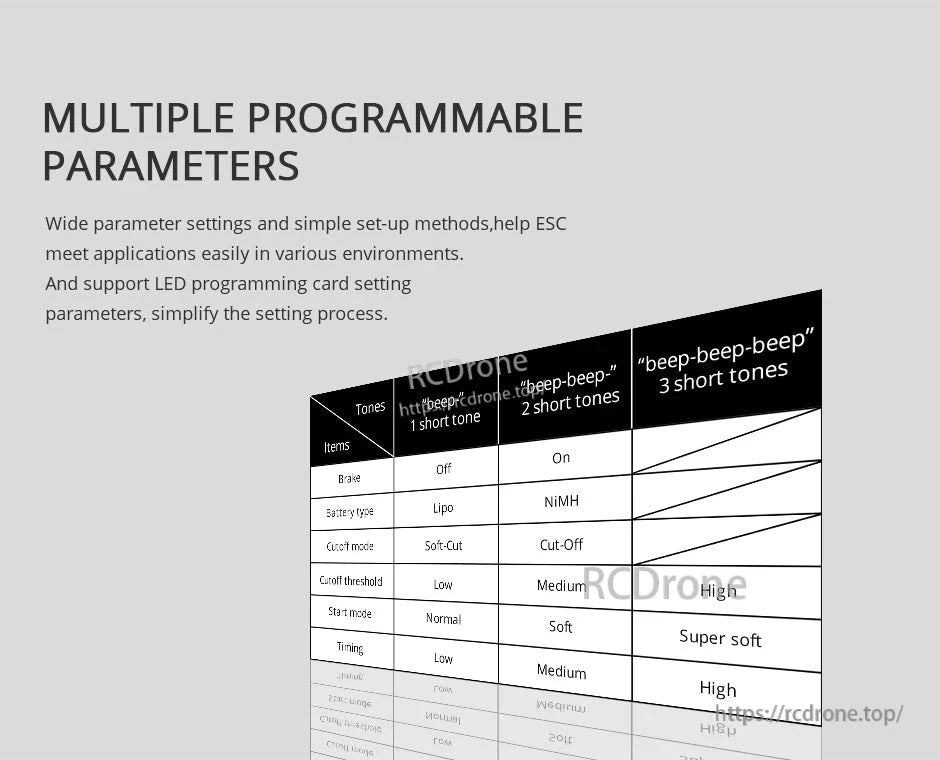
The AT55A-UBEC ESC supports multiple programmable parameters, including brake, LiPo/NiMH battery type, cutoff settings, start mode, and timing.
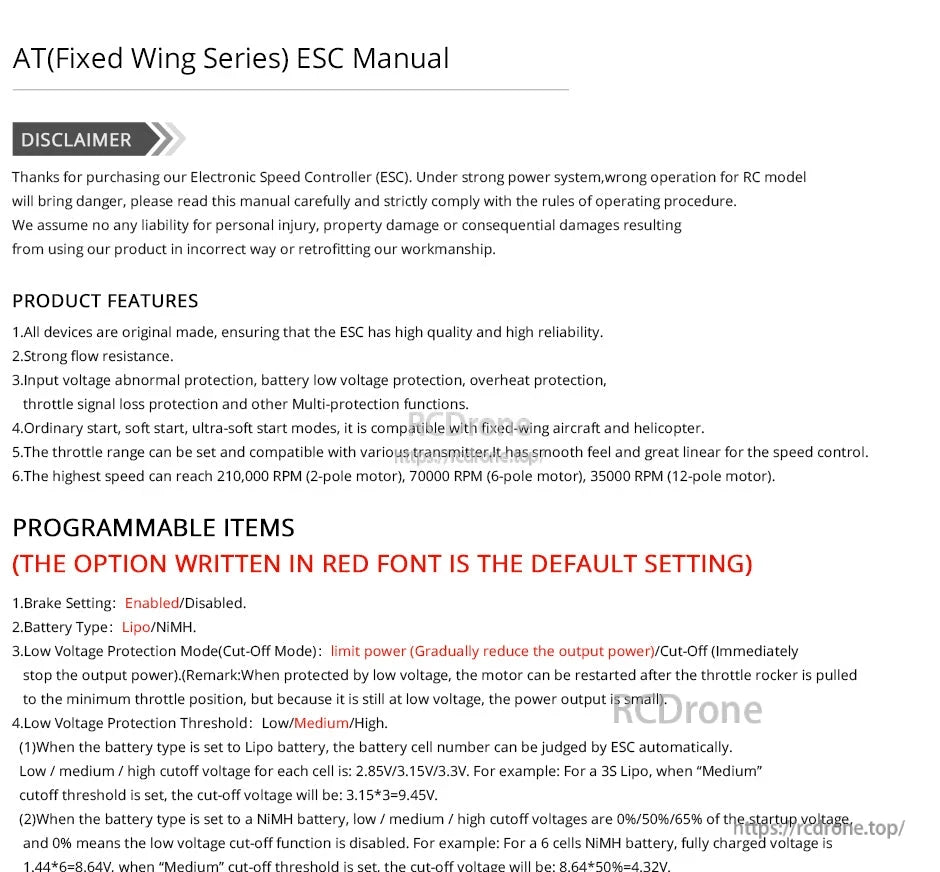
The AT-series fixed wing ESC supports programmable brake, battery type (LiPo/NiMH), and low-voltage protection modes for safer setup.
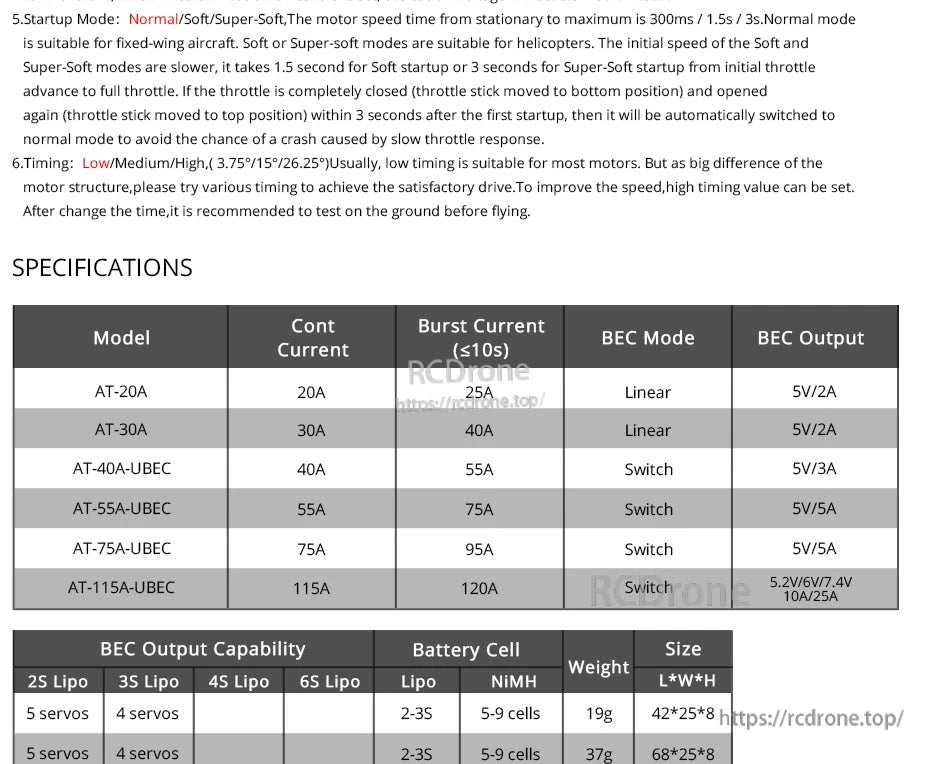
The AT-55A-UBEC ESC is rated for 55A continuous current with up to 75A burst (≤10s) and a switch-mode 5V/5A BEC output.
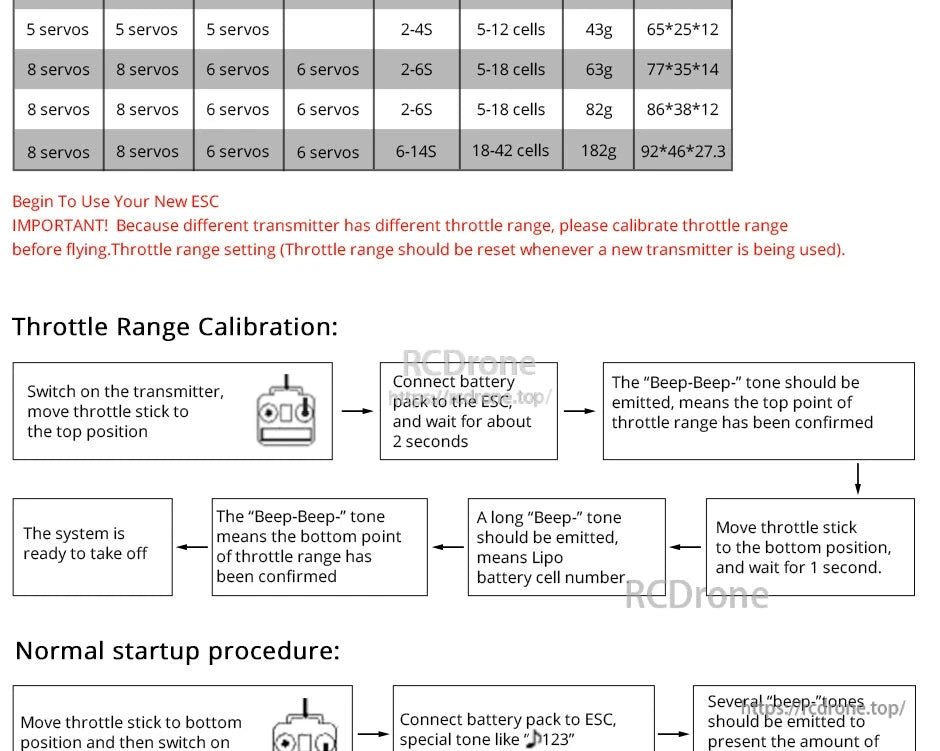
The AT55A-UBEC ESC includes clear throttle range calibration steps and startup beep guidance to help with initial setup and transmitter matching.
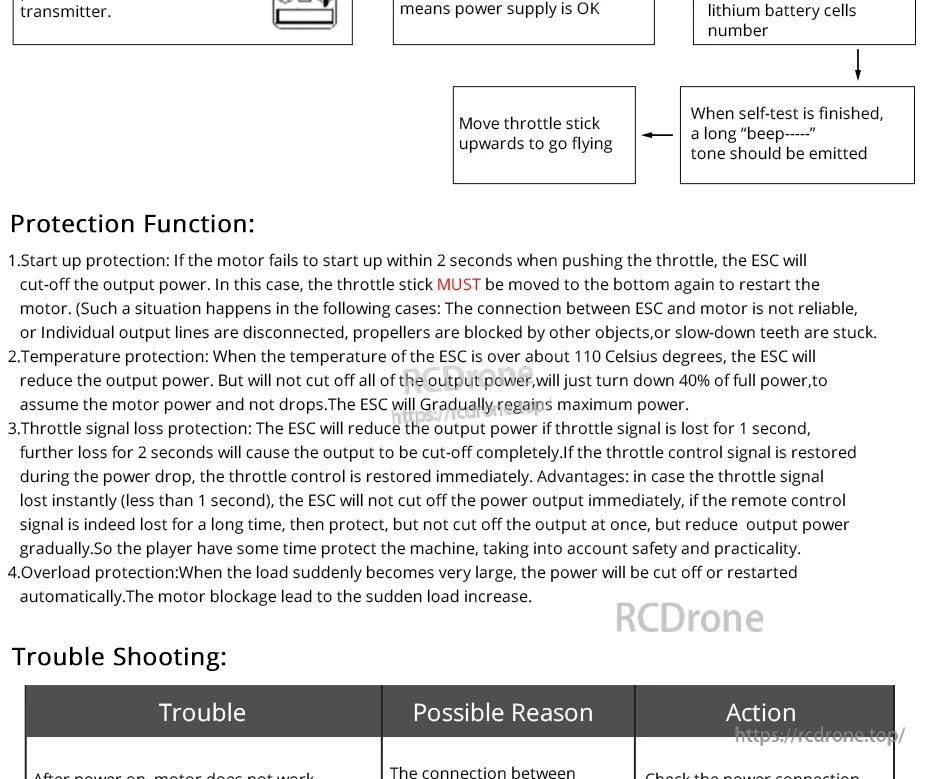
The AT55A-UBEC ESC documentation outlines startup, temperature, throttle-signal loss, and overload protection plus basic troubleshooting steps.
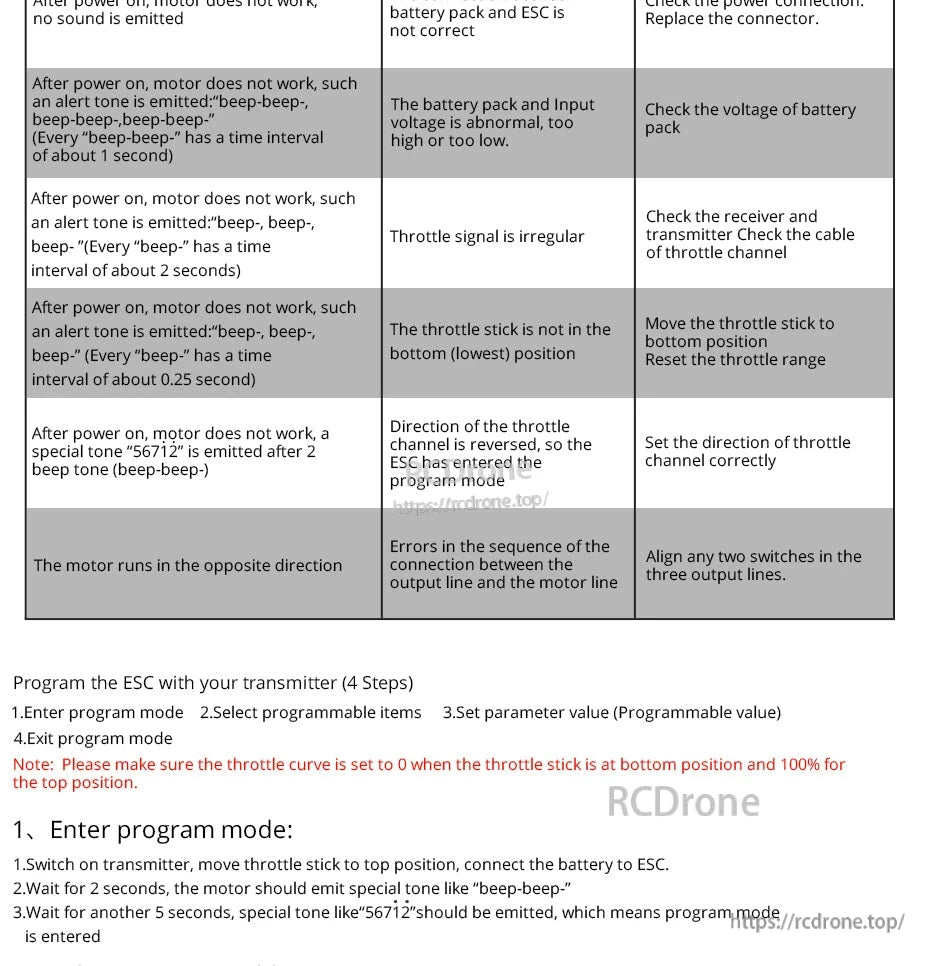
The AT55A-UBEC ESC guide covers common startup beep warnings, connection checks, and the 4-step transmitter programming process.
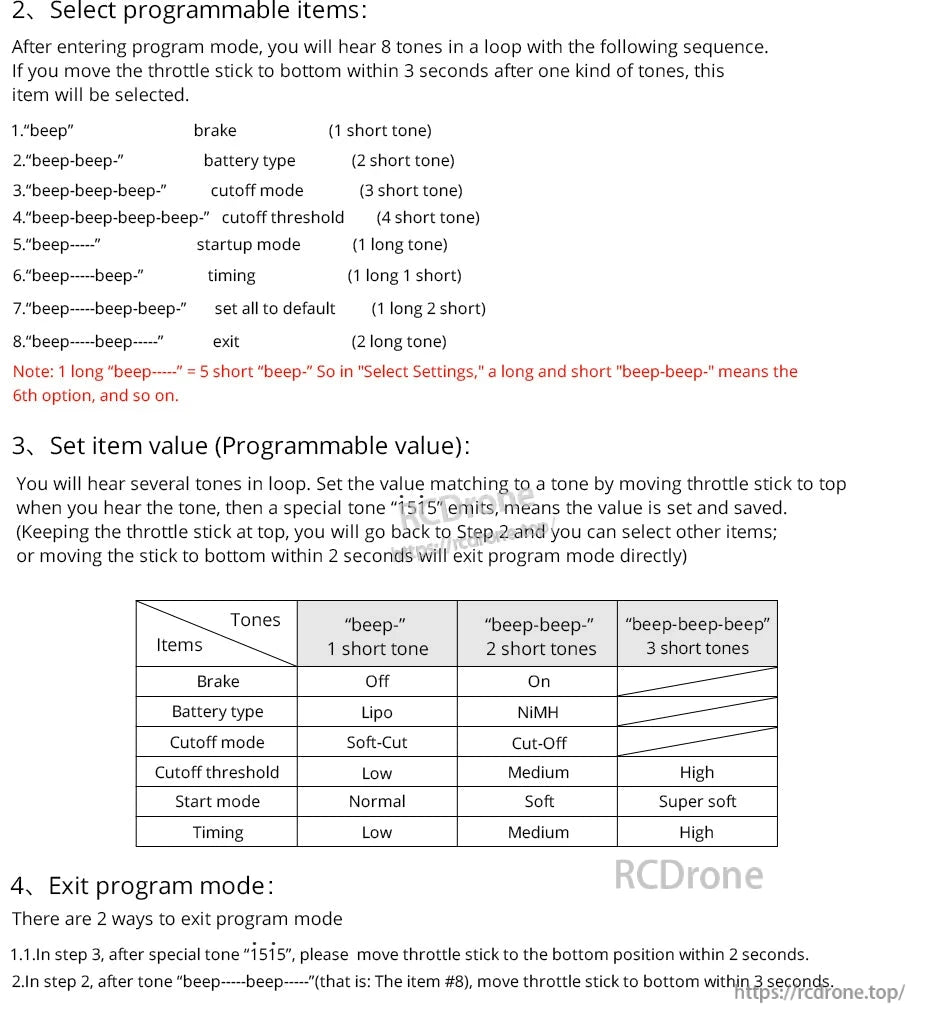
The AT55A-UBEC ESC uses a beep-tone programming menu to set brake, battery type, cutoff mode/threshold, startup mode, and timing.