

Yunshis TOFCAM660 ToF Festkörper-LiDAR-Tiefenkamera 320×240 QVGA 24V GigE/USB für Robotik
Yunshis TOFCAM660 ToF Festkörper-LiDAR-Tiefenkamera 320×240 QVGA 24V GigE/USB für Robotik
Yunshis
Verfügbarkeit für Abholungen konnte nicht geladen werden

Übersicht
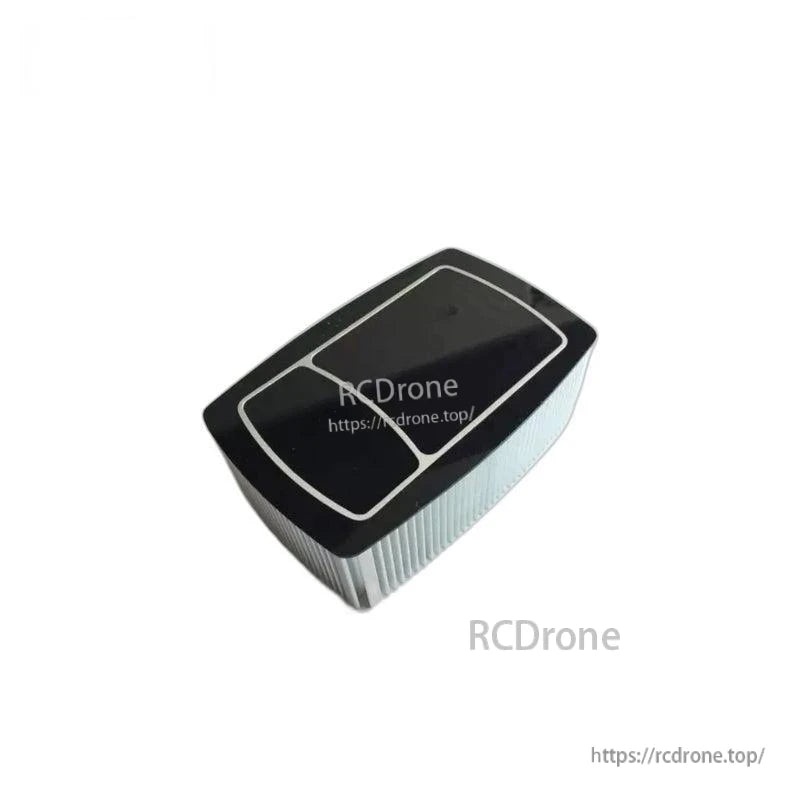
Die Yunshis TOFCAM660 ist eine ToF-Standfest-LiDAR-Tiefenkamera, die für Robotik- und Maschinenvisionsanwendungen entwickelt wurde. Sie gibt Tiefenkarten, Punktwolken und Graustufen-/Amplitudebilder aus, mit einer Auflösung von 320 × 240 (QVGA) und einer Stromversorgung von 24 VDC.
Hauptmerkmale
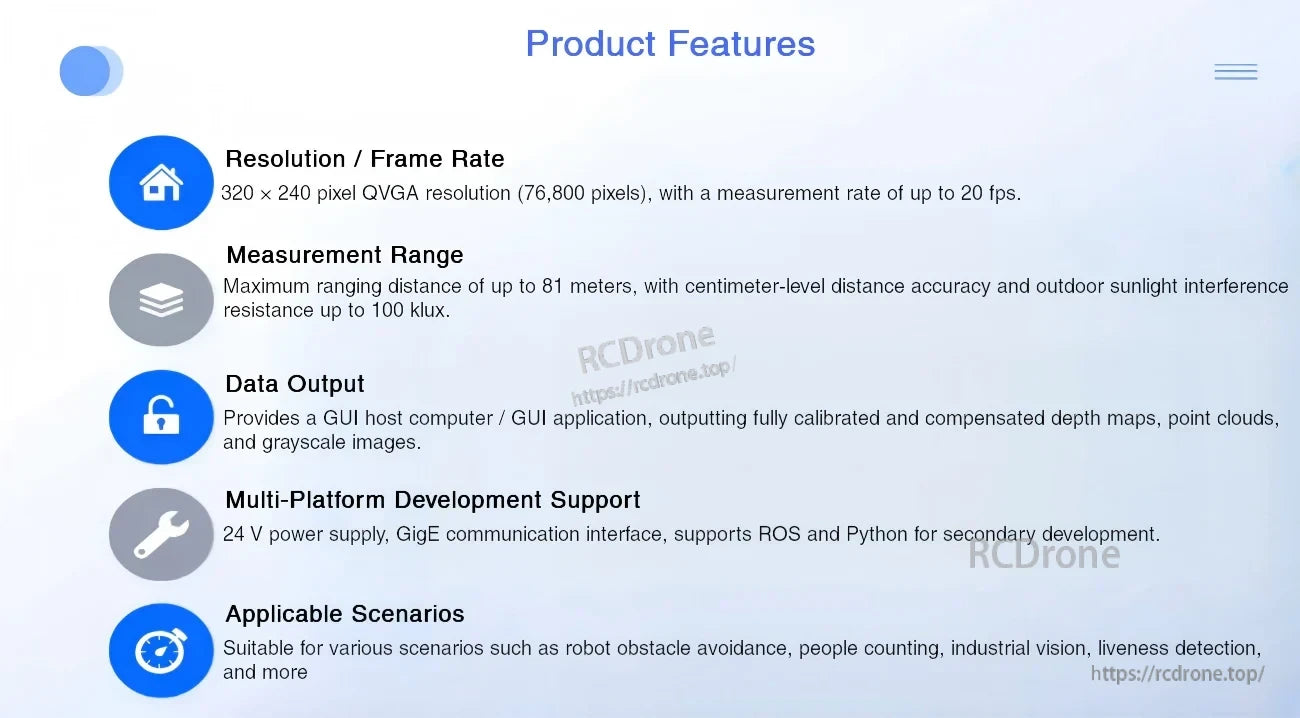
- ToF-Standfest-LiDAR-Tiefensensorik: 320 × 240 Pixel QVGA (76.800 Pixel).
- Messrate: bis zu 20 fps.
- Maximale Reichweite (Funktionsfolie): bis zu 81 m.
- Widerstand gegen Außenlicht: Unterdrückung von Umgebungslicht > 100 kLux (indirekt, auf Ziel); die Funktionsfolie gibt an, dass die Widerstandsfähigkeit gegen Sonnenlicht im Freien bis zu 100 klux beträgt.
- Schnittstellen (Funktionsfolie): Dateninterface GigE / USB; der mechanische Entwurf zeigt einen RJ45-Stecker (LAN-Anschluss) mit Status-LED und einen Strom-/GPIO-Anschluss.
- Softwareunterstützung (Funktionsfolie): SDK für Ubuntu / Windows; unterstützt ROS und Python für die sekundäre Entwicklung.
- Datenoutputs (Funktionsfolie): vollständig kalibrierte und kompensierte Tiefenkarten, Punktwolken und Graustufenbilder (Amplitude als logarithmische Graustufen in den Beispielabbildungen dargestellt).
Für Integrationsfragen, Dokumentationshilfe oder Projektkompatibilitätsberatung kontaktieren Sie den Support unter https://rcdrone.top/ oder senden Sie eine E-Mail an [email protected].
Anwendungen
- Humanoide Roboter
- Roboterarme
- Exoskelette
- Quadruped-Roboter
- AGV-Fahrzeuge
- ARU-Roboter
- Roboter-Hindernisvermeidung
- Personenzählung
- Industrielle Vision
- Lebenszeichen-Erkennung (wie in den Produktmerkmalen angegeben)
Technische Daten
Elektrisch / Optisch
| Netzspannung (VCO) | Typisch 24 VDC (Ripple < 50 mVPP) |
| Versorgungsstrom (ICO) | Einheiten: A (Wert nicht angegeben) |
| Betriebswellenlänge (λ) | 940 nm |
| Bildauflösung (RES_RANGE) | 320 × 240 Pixel (QVGA) |
Sichtfeld (FoV)
| Version NF | 31 × 24° |
| Version SF | 70 × 51° |
| Version WF | 108 × 77° |
| Version UWF | 125 × 93° |
| FoV-Hinweis (Funktionsfolie) | Variabel je nach Reichweite |
Messbereich
| Messbereich im Dunkeln (DR), Version NF | Min 0.5 m, Max 96 m (2% Genauigkeit bei 90% reflektierendem Ziel, dunkel) |
| Messbereich im Dunkeln (DR), Version SF | Min 0,3 m, Max 38 m (2% Genauigkeit bei 90% reflektierendem Ziel, dunkel) |
| Messbereich im Dunkeln (DR), Version WF | Min 0,2 m, Max 18 m (2% Genauigkeit bei 90% reflektierendem Ziel, dunkel) |
| Messbereich im Dunkeln (DR), Version UWF | Min 0,2 m, Max 12 m (2% Genauigkeit bei 90% reflektierendem Ziel, dunkel) |
| Messbereich bei vollem Sonnenlicht (DM), Version NF | Min 0,5 m, Max 38 m (2% Genauigkeit bei 90% reflektierendem Ziel, 100 kLux Umgebungslicht) |
| Messbereich bei vollem Sonnenlicht (DM), Version SF | Min 0,2 m, Max 10 m (2% Genauigkeit bei 90% reflektierendem Ziel, 100 kLux Umgebungslicht) |
| Messbereich bei vollem Sonnenlicht (DM), Version WF | Min 0.2 m, Max 5 m (2% Genauigkeit bei 90% reflektierendem Ziel, 100 kLux Umgebungslicht) |
| Messbereich bei vollem Sonnenlicht (DM), Version UWF | Min 0,2 m, Max 4 m (2% Genauigkeit bei 90% reflektierendem Ziel, 100 kLux Umgebungslicht) |
| Maximaler Bereich (Funktionsfolie) | 81 m |
| Arbeitsbereich (Funktionsfolie) | 11 m / 25 m / 81 m |
Genauigkeit
| Genauigkeit, Messbereich min ... 2 m (Gen) | ±4 cm (Mittelwert von 100 Proben) |
| Genauigkeit, 2 m ... Messbereich max (Gen) | ±2 % |
| Genauigkeit (Funktionsfolie) | < 0,05% |
Modulation / Eindeutigkeit / Vermeidung von Mehrkamera-Interferenzen
| Modulationsfrequenz wählbar (fMOD) | Min 0.75 MHz, Max 24 MHz (verweisen auf den Eindeutigkeitsbereich) |
| Eindeutigkeitsbereich (DUnambiguity) @ fMOD = 24 MHz | 6,25 m |
| Eindeutigkeitsbereich (DUnambiguity) @ fMOD = 12 MHz | 12,5 m |
| Eindeutigkeitsbereich (DUnambiguity) @ fMOD = 6 MHz | 25 m |
| Eindeutigkeitsbereich (DUnambiguity) @ fMOD = 3 MHz | 50 m |
| Eindeutigkeitsbereich (DUnambiguity) @ fMOD = 1,5 MHz | 100 m |
| Eindeutigkeitsbereich (DUnambiguity) @ fMOD = 0.75 MHz | 200 m |
| fSHIFT-Kanal | Wert | Kommentar |
|---|---|---|
| Kanal 0 | 0 MHz | Um Interferenzen in einer Umgebung mit mehreren Kameras zu vermeiden |
| Kanal 1 | -fMOD / 30 MHz | Um Interferenzen in einer Umgebung mit mehreren Kameras zu vermeiden |
| Kanal 2 | -fMOD / 34 ungefährMHz | Um Interferenzen in einer Umgebung mit mehreren Kameras zu vermeiden |
| Kanal 3 | -fMOD / 40 MHz | Um Interferenzen in einer Umgebung mit mehreren Kameras zu vermeiden |
| Kanal 4 | -fMOD / 48 MHz | Um Interferenzen in einer Umgebung mit mehreren Kameras zu vermeiden |
| Kanal 5 | -fMOD / 60 MHz | Um Interferenzen in einer Umgebung mit mehreren Kameras zu vermeiden |
| Kanal 6 | -fMOD / 80 MHz | Um Interferenzen in einer Umgebung mit mehreren Kameras zu vermeiden |
| Kanal 7 | -fMOD / 120 MHz | Um Interferenzen in einer Umgebung mit mehreren Kameras zu vermeiden |
| Kanal 8 | -fMOD / 240 MHz | Um Interferenzen in einer Umgebung mit mehreren Kameras zu vermeiden |
| Kanal 9 | +fMOD / 240 MHz | Um Interferenzen in einer Umgebung mit mehreren Kameras zu vermeiden |
| Kanal 10 | +fMOD / 120 MHz | Um Interferenzen in einer Umgebung mit mehreren Kameras zu vermeiden |
| Kanal 11 | +fMOD / 80 MHz | Um Interferenzen in einer Umgebung mit mehreren Kameras zu vermeiden |
| Kanal 12 | +fMOD / 60 MHz | Um Interferenzen in einer Umgebung mit mehreren Kameras zu vermeiden |
| Kanal 13 | +fMOD / 48 MHz | Um Interferenzen in einer Umgebung mit mehreren Kameras zu vermeiden |
| Kanal 14 | +fMOD / 40 MHz | Um Interferenzen in einer Umgebung mit mehreren Kameras zu vermeiden |
| Kanal 15 | +fMOD / 34 ca.MHz | Um Störungen in einer Umgebung mit mehreren Kameras zu vermeiden |
| Kanal 16 | +fMOD / 30 MHz | Um Störungen in einer Umgebung mit mehreren Kameras zu vermeiden |
Timing
| Integrationszeit wählbar für Distanz (tINT) | Min 1 µs, Max 4'000 µs |
| Integrationszeit wählbar für Graustufen (tINT) | Min 1 µs, Max 100'000 µs |
| Messzykluszeit für vollständiges TOF-Bild (tCYCLE) | Einheiten: s; Wert nicht angegeben (@ tINT = 1'000 µs) |
| Hochlaufzeit bis zur Annahme von Befehlen (tPWR_UP) | Max 1.5 s |
| Aufwärmzeit bis die Ausgabedaten im Toleranzbereich sind (tWARM_UP) | Einheiten: s; Wert nicht angegeben |
Umwelt / Zuverlässigkeit / Konformität
| Umgebungslichtunterdrückung (ΦAL) | Typisch > 100 kLux (indirekt, auf Ziel) |
| Umgebungstemperaturbereich (TA) | Min -20 °C, Max 60 °C (Betrieb und Lagerung) |
| Relative Luftfeuchtigkeit (RH) | Min 15%, Max 90% (nicht kondensierend) |
| ESD-Bewertung | JEDEC HBM Klasse 1C (1 kV bis < 2 kV), menschliches Körpermodell |
| EMV-Emission | EN 61000-6-3:2011-09 |
| Augensicherheit | IEC 62471:2006 |
Mechanisch
| Gewicht (W) | Typisch 600 g (ohne Kabel) |
| Mechanische Merkmale (beschriftet) | Beleuchtungsfenster (Tx); Objektivfenster (Rx); Kameragehäuse und Kühlkörper; Dekorativer Rahmen |
| Montage | Montagelöcher auf der Rückseite (4x); Löcher für Montageschrauben: 4 × ø 3.5 mm |
| Montageschrauben (Hinweis) | Selbstschneidende Schrauben M5; Gewindelänge min. = 10 mm |
| Steckverbinder / Steuerungen (beschriftet) | Strom- und GPIO-Anschluss; LAN-Anschluss mit Status-LED; RJ45-Buchse; J-Buchse 6-polig; Pin 1; IP-Reset; Grüne Status-LED; Gelbe Status-LED |
| Wichtige Abmessungen im Zeichnungsbild | 136; 89; 46; 50 (Einheiten nicht im Zeichnungsbild angegeben) |
Handbücher
- Yunshis TOFCAM660 LiDAR-Drawing.pdf
- Yunshis TOFCAM660 LiDAR Produktmanual (PDF)
- Yunshis DME660 LiDAR Produktmanual (PDF)
Video
Details
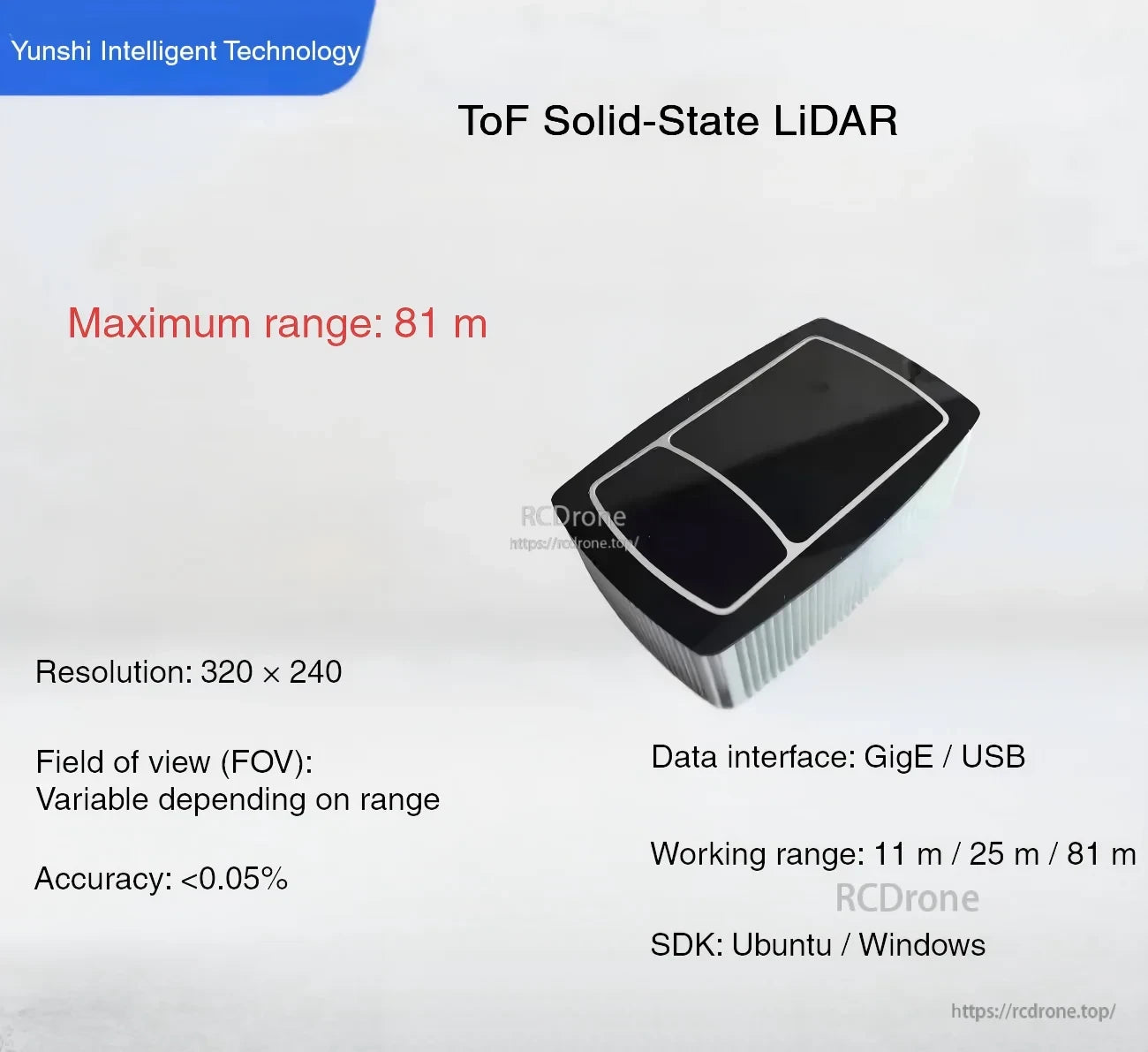
TOFCAM660 ist eine kompakte ToF-Standfest-LiDAR-Tiefenkamera für Robotik und Maschinenvision, mit 320×240 Ausgabe und GigE/USB-Konnektivität.
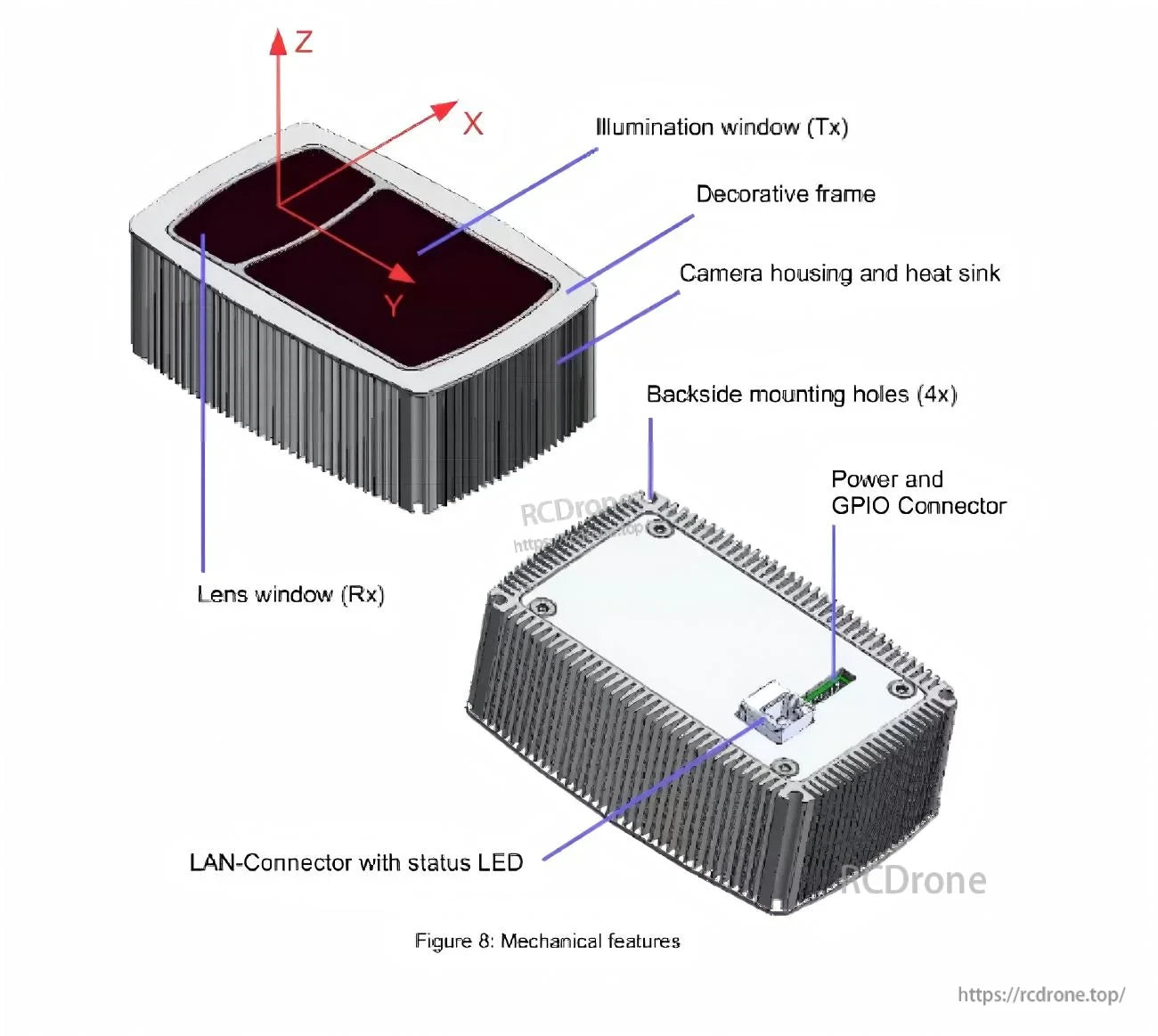
Mehrere Montagemöglichkeiten sowie ein LAN (RJ45)-Anschluss und ein Strom/GPIO-Anschluss erleichtern die Integration in Roboter und Automatisierungssysteme.
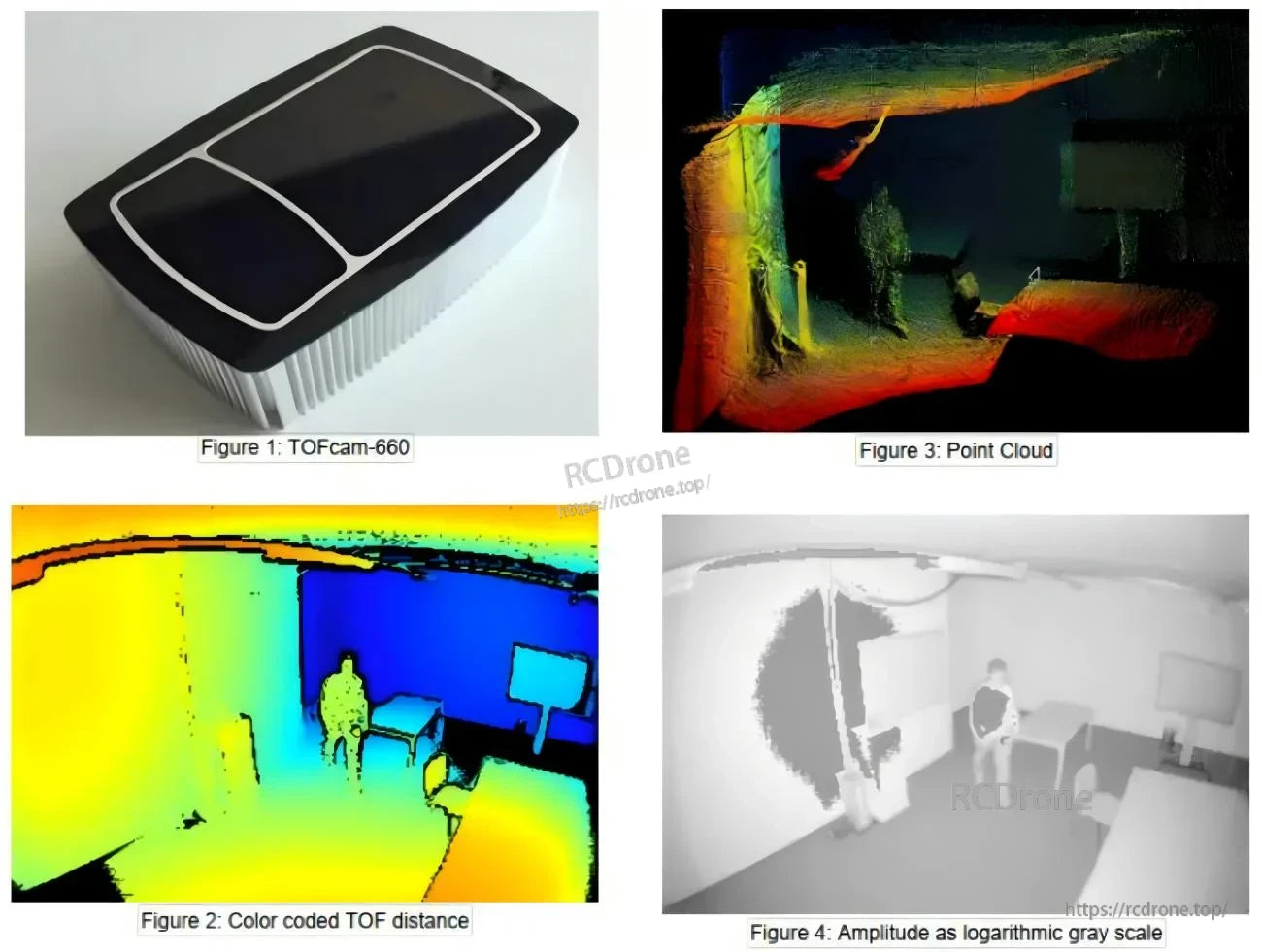
Tiefenkarten, Punktwolken und Amplituden (Graustufen)-Bilder unterstützen Aufgaben wie Hindernisvermeidung, Messung und Szenenverständnis.
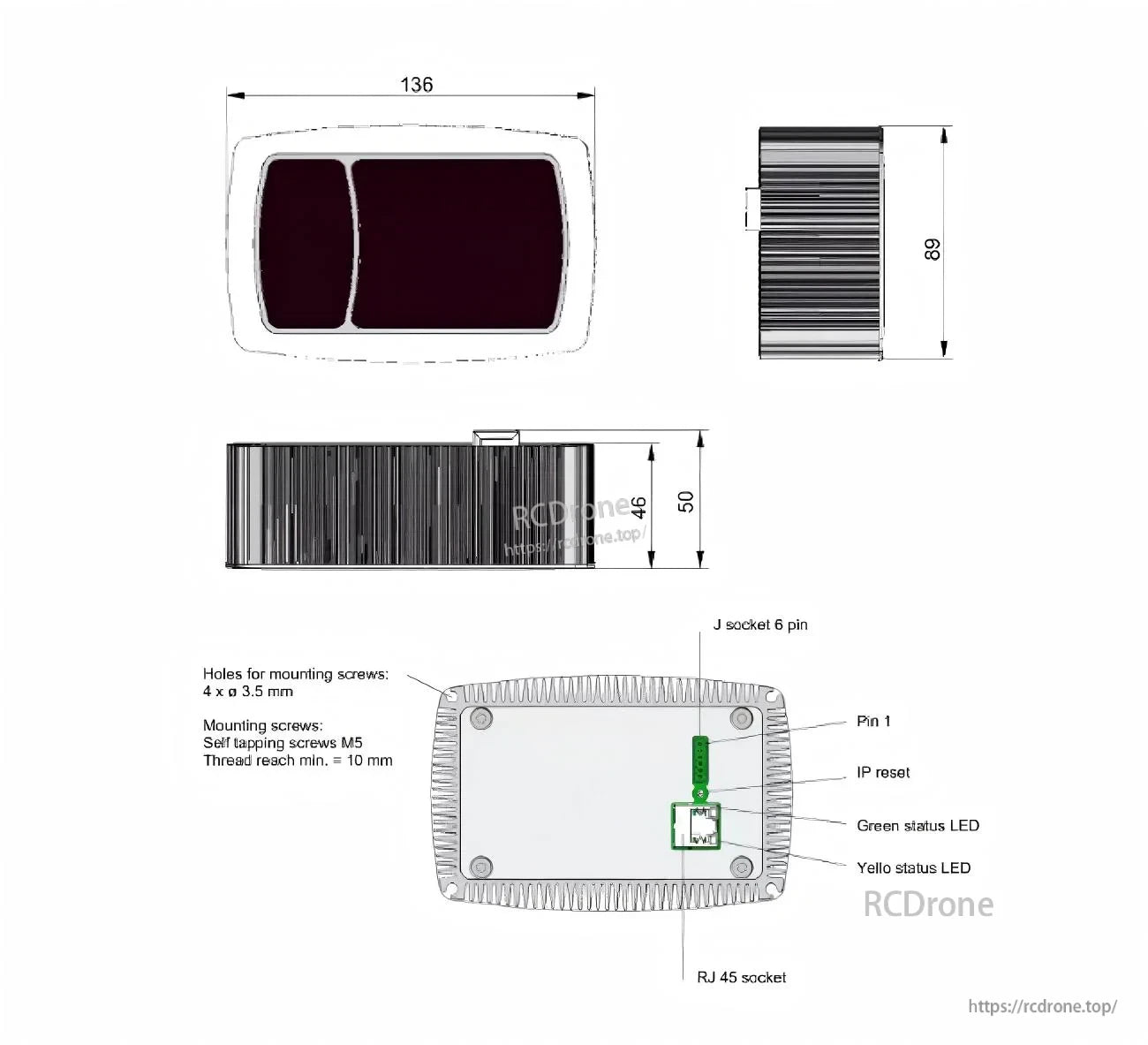
Verwenden Sie die mechanische Zeichnung und die Anschlussbezeichnungen, um den Platz für das Gehäuse, die Platzierung der Montagelöcher und die Kabelverlegung zu planen.