Hiwonder JetArm ROS1/ROS2 Robot Arm — Monocular & 3D Vision Kits with Jetson Options
Hiwonder JetArm ROS1/ROS2 Robot Arm — Monocular & 3D Vision Kits with Jetson Options
Hiwonder
受け取り可能状況を読み込めませんでした


Overview
Hiwonder JetArm is a desktop robot arm for ROS programming, computer vision and robotic grasping education. Its six intelligent bus servos support motion-control experiments, while the choice of monocular or depth camera determines the available vision workflow. Choose Starter, Standard, Advanced or Ultimate hardware, then select a Jetson controller or a configuration without one. Ultimate adds the microphone hardware for voice and multimodal AI projects.
Choose Your Configuration
The kit and controller are two independent selections. A depth camera, screen, microphone array or Jetson board pictured elsewhere on this page is included only when specified by the chosen combination.
| Kit | Camera | 7-inch touchscreen | 6-microphone array | Primary learning focus |
|---|---|---|---|---|
| Starter Kit | Monocular camera | Not included | Not included | 2D vision and robot-arm control |
| Standard Kit | Gemini Plus depth camera | Not included | Not included | RGB+D perception and spatial grasping |
| Advanced Kit | Gemini Plus depth camera | Included | Not included | Depth vision with local screen display |
| Ultimate Kit | Gemini Plus depth camera | Included | Included | Depth vision, voice interaction and multimodal AI |
Controller selections: Without Jetson Controller; Jetson Nano (4 GB); Jetson Orin Nano Super (4 GB or 8 GB); Jetson Orin NX Super (8 GB or 16 GB). A configuration without the Jetson controller requires a suitable separately supplied controller and system setup. Large-model applications are supported by the Ultimate configuration with a Jetson controller and configured software/services; ROS1 does not support the large-model workflow. Intelligent transport and smart-assistant examples require Orin Nano or Orin NX.
Features
- Anodized aluminum-alloy frame, industrial bearing base and concealed servo wiring provide a compact desktop mechanism with a mechanical gripper.
- Jetson host processing and an STM32 real-time motion controller separate vision/AI processing from servo control and feedback.
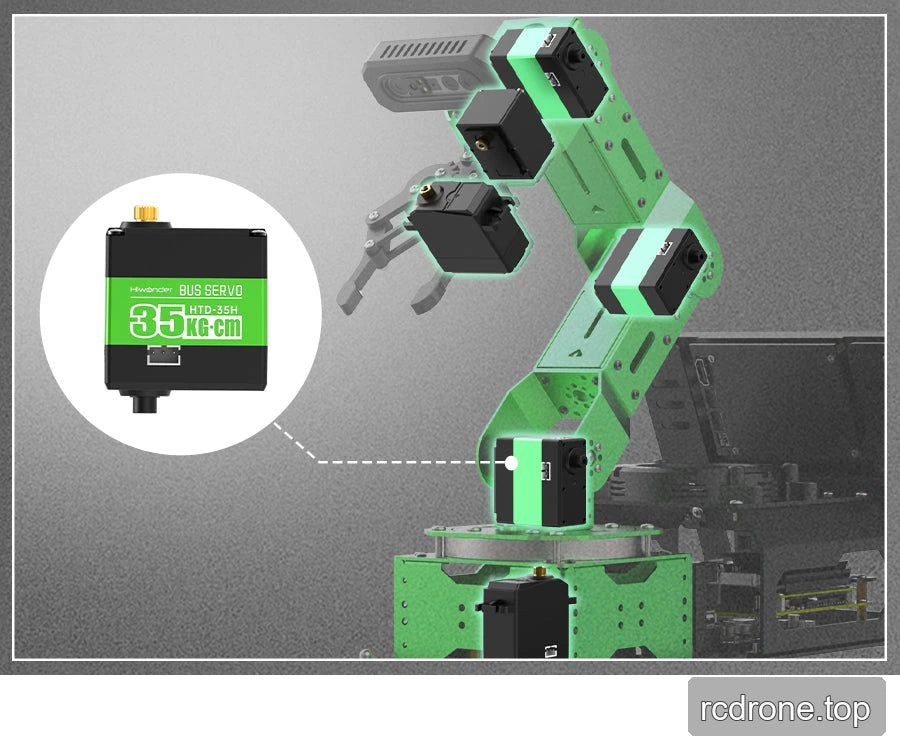
- Six intelligent bus servos provide position, voltage and temperature feedback, with stall and overtemperature protection. Servo stall torque is a component rating, not a robot-arm payload rating.
- Depth-camera kits combine RGB and depth data for point clouds, ranging, height/volume estimation, object positioning, spatial tracking and grasping.
- Motion development includes DH modeling, forward and inverse kinematics, coordinate conversion, path planning and action-sequence editing.
- Vision examples include color recognition/sorting/tracking, AprilTag pose estimation and stacking, KCF tracking, mask identification, human-body detection, face tracking, gesture recognition and fingertip trajectories with MediaPipe.
- Custom object-model training and TensorRT/GPU acceleration support recognition and sorting projects. Tutorials span YOLOv5, YOLOv8 and newer YOLOv11 software examples; the installed image determines the available implementation.
- Ultimate adds six-channel far-field sound pickup, noise reduction, sound-source localization, wake-up, configurable commands, speech output and voice-controlled recognition, tracking and sorting.
- Control through an iOS/Android app, wireless gamepad, computer software, USB serial and CAN interfaces. Remote-development examples include NoMachine, SSH, Wi-Fi AP/STA configuration and serial/I²C communication.
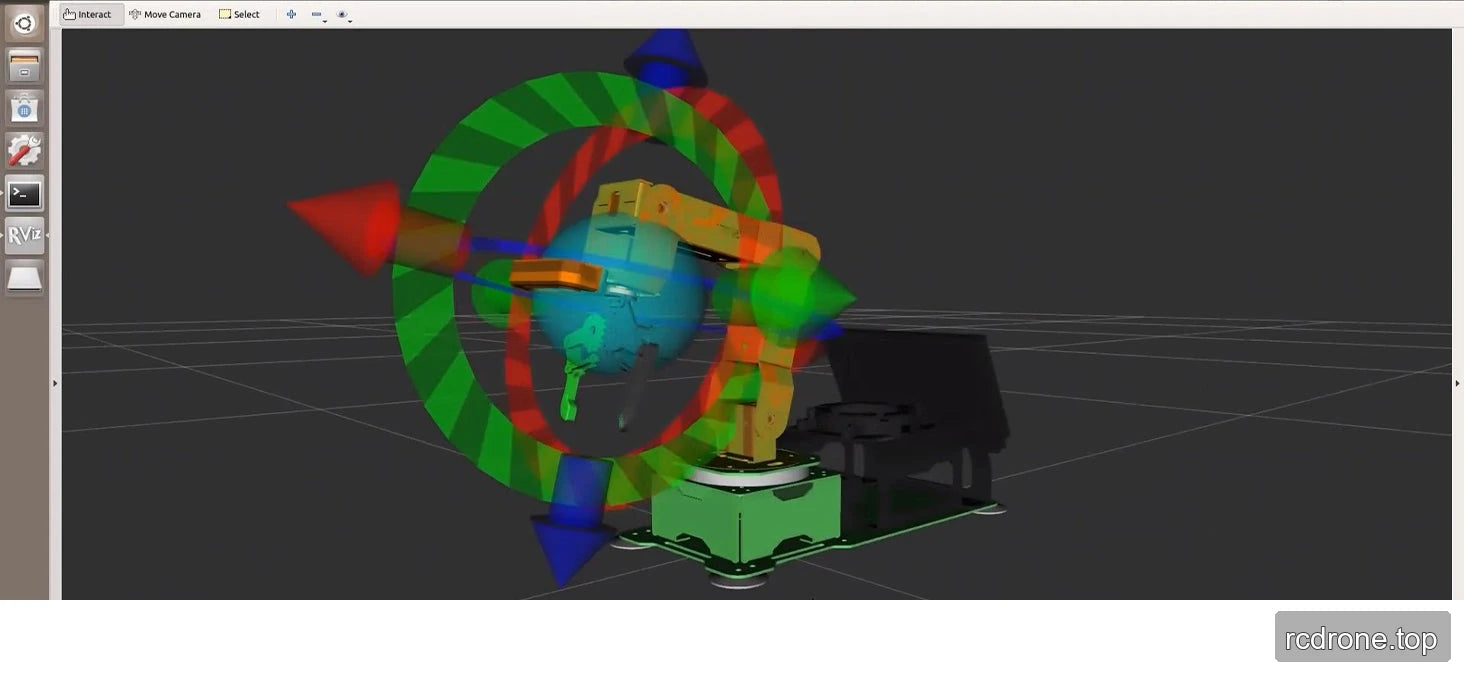
- URDF visualization, MoveIt configuration/control and Gazebo simulation support virtual testing. Expansion projects cover a sliding rail and mobile chassis; these expansion systems are separate from the listed kit contents.
Specifications
| Item | Specification |
|---|---|
| Product model | JetArm |
| Product dimensions | 339 × 165 × 532 mm |
| Product weight | Approx. 2.4 kg (ultimate version) |
| Body material | Full-metal aluminum alloy frame, anodized surface treatment |
| STM32 controller | STM32F407-series ROS motion controller with FreeRTOS; component panel identifies STM32F407VET6. |
| ROS controller | Jetson Nano / Jetson Orin Nano / Jetson Orin NX |
| Control methods | USB serial port, CAN interface, Bluetooth app, RC transmitter, computer |
| USB expansion | 5A high-current USB HUB expansion board |
| Camera | Starter: monocular camera. Standard, Advanced and Ultimate: Gemini Plus depth camera. |
| Power supply | 12 V 5 A robotic-arm supply. Orin Nano and Orin NX configurations also require the 19 V 2.37 A controller supply. |
| Operating system | ROS Humble / Ubuntu 22.04 LTS and ROS Noetic / Ubuntu 20.04 LTS platform options; installation differs by controller (see Software and Setup). |
| Software | iOS/Android app |
| Communication | USB / Wi-Fi / Ethernet |
| Programming language | Python / C / C++ / JavaScript |
| Storage | With-controller configurations: Jetson Nano, 64 GB TF card; Jetson Orin Nano/NX, 128 GB SSD. Without-controller selections omit the Jetson board. |
| Servo model | HTS-21H/ HTD-35H/ HX-12H smart bus servo motors |
| Optional accessories | 7-inch HD touchscreen: Advanced and Ultimate. Circular 6-microphone array: Ultimate. |
| Supporting materials | Full development manuals, video tutorials, ROS/STM32 source code, system images, software tools |
| Package weight & volume | Reference package: 385 × 295 × 175 mm; the description lists 4 kg, while all current variant records list 5.5 kg. These are inconsistent package-weight records; neither is the 2.4 kg Ultimate robot net weight. |
Additional annotations in the mechanical drawing are 55, 96, 119, 142, 158, 171, 129, 103, 162, 300 and 429 mm at the marked locations. Read these against the retained drawing rather than treating them as a motion envelope or payload specification.
Jetson Controller Reference
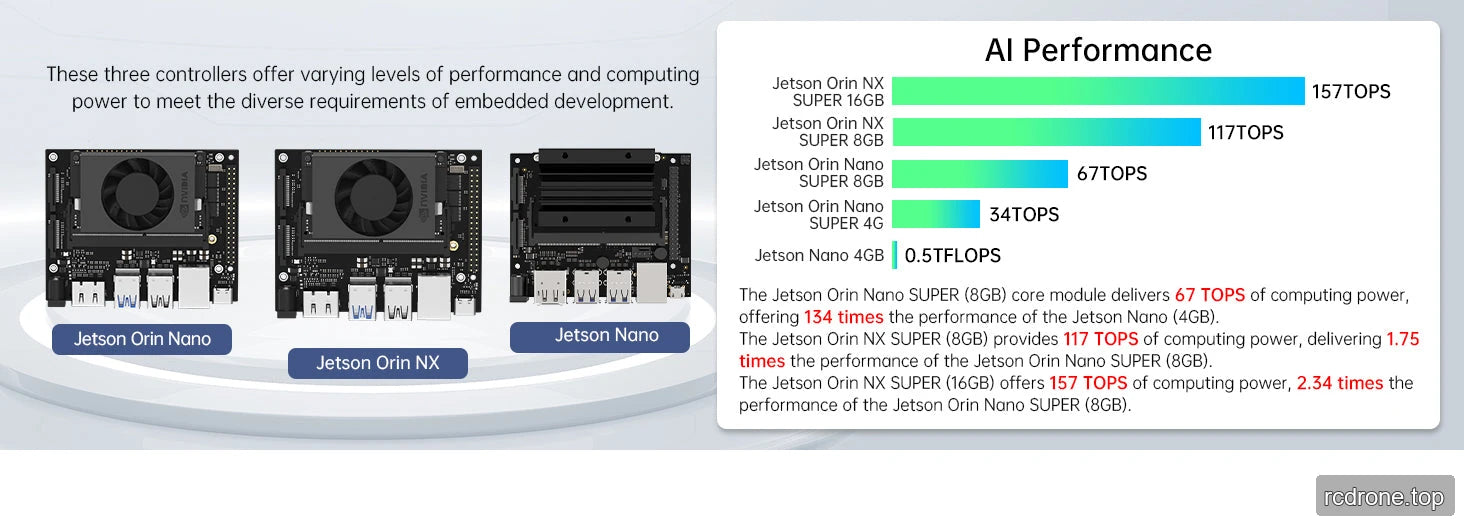
Compute figures below describe controller-module reference capabilities, not measured robot-arm throughput. TOPS and TFLOPS are different metrics; the earlier 134× and 2.34× promotional comparisons are not universal performance ratios.
| Parameter | Nano 4 GB | Orin Nano Super 4 GB | Orin Nano Super 8 GB | Orin NX Super 8 GB | Orin NX Super 16 GB |
|---|---|---|---|---|---|
| Storage | 64 GB TF | 128 GB SSD | 128 GB SSD | 128 GB SSD | 128 GB SSD |
| Compute reference | 0.5 TFLOPS | 34 TOPS | 67 TOPS | 117 TOPS | 157 TOPS |
| CPU | Quad-core Cortex-A57 | 6-core Cortex-A78AE v8.2 64-bit; 1.5 MB L2 + 4 MB L3 | Same 6-core CPU | 6-core Cortex-A78AE v8.2 64-bit; 1.5 MB L2 + 4 MB L3 | 8-core Cortex-A78AE v8.2 64-bit; 2 MB L2 + 4 MB L3 |
| GPU | 128-core Maxwell | 512-core Ampere, 16 Tensor Cores | 1024-core Ampere, 32 Tensor Cores | 1024-core Ampere, 32 Tensor Cores | 1024-core Ampere, 32 Tensor Cores |
| Memory | 4 GB 64-bit LPDDR4, 25.6 GB/s | 4 GB 64-bit LPDDR5, 51 GB/s | 8 GB 128-bit LPDDR5, 102 GB/s | 8 GB 128-bit LPDDR5, 102.4 GB/s | 16 GB 128-bit LPDDR5, 102.4 GB/s |
| Listed power modes | 5 / 10 W | 7 / 10 / 25 W | 7 / 15 / 25 W | 10 / 15 / 25 / 40 W | 10 / 15 / 25 / 40 W |
Controller Software Timing Reference
These are illustrative values from the platform comparison, with workload conditions as stated below. They are not guaranteed startup, inference or training times for every configuration.
| Task | Orin NX Super | Orin Nano Super | Jetson Nano |
|---|---|---|---|
| Startup | 48 s | 48 s | 65 s |
| System software opening | 0.1–0.5 s | 0.1–0.9 s | 1–3 s |
| Large-model embodied-intelligence application startup | 10–20 s | 15–25 s | 40–60 s |
| YOLOv11 model learning: 500 images, 12 categories, 100 training iterations | 20 min | 28 min | 3.9 h |
| Basic vision: startup / frame rate | 10–11 s / 30 fps | 10–14 s / 30 fps | 20–25 s / 30 fps |
| Advanced 3D vision: startup / frame rate | 10–11 s / 30 fps | 10–14 s / 30 fps | 27–30 s / 15–20 fps |
| MediaPipe: startup / frame rate | 10–11 s / 30 fps | 10–14 s / 30 fps | 20–25 s / 13–15 fps |
| Simulation: startup / frame rate | 10–18 s / 30–60 fps | 10–20 s / 30–60 fps | 17–35 s / 15–60 fps |
YOLO Software Reference
The retained comparison discusses YOLOv8 and YOLOv11 architecture, detection, segmentation, classification, pose estimation and oriented bounding boxes. It lists 37.3–53.9% versus 39.5–54.7% accuracy ranges without defining the dataset or metric, and 2.66 ms versus 2.5 ms inference on T4 with TensorRT. These generic software-reference figures are not JetArm accuracy or inference guarantees. The newer architecture reference names C3k2 and C2PSA; custom training and model-quantization deployment depend on the selected software environment.
Gemini Plus Depth Camera — Standard, Advanced and Ultimate
| Parameter | Value |
|---|---|
| Depth technology | Orbbec active binocular structured light |
| Operating range | 0.25–2.5 m |
| Accuracy | 5 mm at 1 m |
| Depth field of view | H 71° × V 56.7° |
| RGB field of view | H 67.9° × V 45.3° |
| Processing chip | MX6000 |
| UVC / close-range protection | Supported |
| Depth output, USB 2.0 | 1280 × 800 at 7 fps; 640 × 400 at 30 fps |
| Depth output, USB 3.0 | 1280 × 800 at 30 fps; 640 × 400 at 60 fps |
| RGB output, USB 2.0 | 1280 × 720 at 7 fps; 640 × 480 at 30 fps |
| RGB output, USB 3.0 | 1920 × 1080 at 30 fps; 1280 × 720 at 30 fps; 640 × 480 at 30 fps |
| OS / SDK | Android, Linux and Windows; depth, RGB, skeleton and related data; filtering algorithms |
| Connection | USB 3.0 |
| Environment | Indoor and outdoor |
| Power consumption | Less than 2.2 W |
| Dimensions | 65.3 × 22.5 × 13 mm |
| Laser classification | Class 1, as specified for the camera module |
| Operating temperature | 10–40 °C |
| Optical components | RGB camera, two IR cameras, IR projector, floodlight and proximity sensor |
Bus Servo Reference
| Parameter | HTD-35H | HX-12H | HTS-21H |
|---|---|---|---|
| Component weight | 64 g | 36.3 g | 63 g |
| Dimensions | 51.1 × 20.14 × 40 mm | 35.19 × 26.19 × 27.2 mm | 40 × 20 × 40.5 mm |
| Operating voltage | 9–12.6 V | 9–12.6 V | 9–12.6 V |
| Speed at 11.1 V | 0.18 s / 60° | 0.2 s / 60° | 0.16 s / 60° |
| Stall torque at 11.1 V | 35 kg·cm | 12 kg·cm | 21 kg·cm |
Shared servo specifications: 0–240° rotation; UART serial command control at 115200 baud; metal gearing; stall and overtemperature protection; temperature, voltage and position feedback.
STM32 Motion Controller
| Parameter | Value |
|---|---|
| Controller | STM32F407VET6, 100 pins; FreeRTOS |
| Input / regulated output | 7–14 V input; one 5 V 5 A supply output |
| Switch | Large circuit toggle switch |
| Motor driver | YX4055 |
| PWM / DC motor ports | Two PWM servo channels; two PH2.0×2 DC motor channels |
| USB serial | One USB-C serial port |
| I²C | Two 4-pin I²C interfaces |
| GPIO expansion | Two 4-pin GPIO interfaces, four GPIOs total |
| Board dimensions / mounting-hole spacing | 38 × 93 mm / 30 × 85 mm |
| Protection | Overheating, short circuit and overcurrent |
| Indicators and controls | Two programmable LEDs, two programmable buttons, passive buzzer; onboard supply-voltage detection and Bluetooth indicator |
| Bus-servo connectors | The parameter table lists two bus-servo channels; the annotated board graphic and function list label four connectors. Verify the supplied board revision before wiring. |
USB Expansion Hub
| Parameter | Value |
|---|---|
| Weight / dimensions | 20.3 g / 86 × 37.8 × 9.5 mm |
| Working voltage | 5 V |
| Data input / output | USB-C / four USB 2.0 ports |
| Transmission speed | 480 Mbps |
| External supply voltage | 9–24 V |
| No-load current | 1 mA at 12 V |
| Power / protection | 5 A DC-DC supply; overcurrent and overheat protection |
| Expansion | Thin, stackable, cascade-capable design; driver-free operation |
Six-Microphone Module — Ultimate Kit
| Parameter | Value |
|---|---|
| Microphones | Six-channel circular array with sound-card adapter and speaker |
| Pickup reference | Up to 10 m; actual pickup depends on environment |
| Functions | Sound-source localization, noise reduction, customized commands and multiple wake-up commands |
| Command limit | Multiple configurable voice commands; each command must not exceed 10 words |
| Recognition engine | Configurable iFlytek offline speech-recognition engine |
Software and Setup
The Orin controller comparison specifies ROS1 in Ubuntu 20.04 Docker and ROS2 preinstalled with Ubuntu 22.04. For Jetson Nano it specifies a preinstalled Ubuntu 18.04 environment and ROS2 in Ubuntu 22.04 Docker. Use the image and instructions for the selected controller; the general ROS Noetic/Humble platform listing does not mean every operating system is preinstalled on every option. Large-model features are unavailable in ROS1.
For Orin Nano and Orin NX, connect the 19 V 2.37 A main-controller supply first, then the 12 V 5 A STM32/arm supply, following the controller-specific wiring guide. The Nano setup uses the 12 V 5 A supply. For touchscreen operation, connect the USB data cable to the screen's CTOUCH port as well as connecting HDMI.
Place the arm on a stable, flat surface away from the edge of a table. Keep its motion path clear, avoid holding the mechanism stalled and avoid prolonged heavy loading. Camera and module specifications are component-level limits, not an arm payload or reach specification. The dimension drawing illustrates 339 × 165 × 532 mm overall dimensions; it does not establish a 532 mm working reach.
Development materials include manuals, videos, ROS/STM32 source code, system images and software tools. Lessons cover GPIO/input-output processing, serial/PWM/bus-servo control, circuit protection, ROS topics, OpenCV, webcam monitoring, color-space conversion, camera calibration, object-pose calculation, path planning, PID, positioning/grasping and intelligent stacking. Voice lessons cover microphone/sound-card configuration, wake-up, recognition, speech output and voice-guided recognition/tracking/sorting. Multimodal lessons cover language, speech and vision-language models, model access/deployment, emotional-perception examples, voice orchestration, scene understanding, optical-character recognition and embodied tasks; hardware and software prerequisites follow the selected configuration. Follow the JetArm manufacturer tutorial for controller-specific installation, camera calibration, firmware and lessons.
Applications
- ROS motion-control education: build DH and URDF models, compare forward/inverse kinematics and test trajectories in MoveIt and Gazebo before operating the arm.
- Vision-guided sorting: use color, tags or trained object models for classification and grasping. Depth-camera kits add spatial position, point-cloud and height/volume experiments.
- Human–robot interaction: explore gesture and face tracking with MediaPipe. Ultimate configurations add voice commands, scene understanding and multimodal language/vision experiments.
- Expansion development: combine programmed arm control with separately supplied sliding-rail or mobile-base projects using the base interfaces and development materials.
What's Included
Each kit supplies an assembled JetArm with the camera specified in the kit table. The common learning accessories are: one 12 V 5 A adapter, one card reader, one wireless gamepad, four suction cups, one screwdriver/accessory set, one waste-card set, seven wooden blocks (four 40 mm blocks and three 30 mm blocks), three colored 30 mm blocks, three 30 × 30 mm tags, one roll of double-sided tape, two cuboids, two cylinders, one ball, one map and one user manual.
The accessory set is listed as one screwdriver, eight A2.5 self-tapping screws, eight M2.5 flat-head screws, eight M3×6 screws, sixteen M4×6 screws, one 100 mm servo cable and one 200 mm servo cable. The common packing illustration labels the 12 V adapter connector as two-prong DC 4.0 × 1.7 mm; use the actual controller-specific power guide for connection.
- Starter: monocular camera; no depth camera, screen or microphone array.
- Standard: Gemini Plus depth camera; no screen or microphone array.
- Advanced: depth camera plus a 7-inch LCD touchscreen, screen bracket, HDMI cable and data cable.
- Ultimate: Advanced hardware plus the circular six-microphone array.
The Jetson board is included only with the selected With Jetson configuration. The supplied storage follows the corresponding controller configuration. Sliding rails, mecanum/tank chassis, conveyors and objects used in demonstrations are separate unless specifically listed in the selected kit.
FAQ
Does the Starter Kit support depth-camera grasping?
Starter includes a monocular camera. Choose Standard, Advanced or Ultimate for the Gemini Plus depth camera and RGB+D spatial-grasping lessons.
Which kit includes voice interaction and the touchscreen?
Advanced and Ultimate include the 7-inch touchscreen. Ultimate also includes the six-microphone array; large-model applications require a Jetson controller and the corresponding software/service setup.
What does Without Jetson Controller mean?
It omits the Jetson host board. You must supply and install a suitable controller and compatible system image before using Jetson-based vision and ROS functions.
Can I use the large-model workflow with ROS1?
No. Use the supported ROS2 environment and Ultimate configuration for the large-model workflow; intelligent transport and smart-assistant examples additionally require Orin Nano or Orin NX.
Do Orin versions use only one power adapter?
No. Orin Nano and Orin NX use separate 19 V 2.37 A and 12 V 5 A supplies. Follow the controller-specific guide and connect the main-controller supply before the STM32/arm supply.
Videos
Visual Details