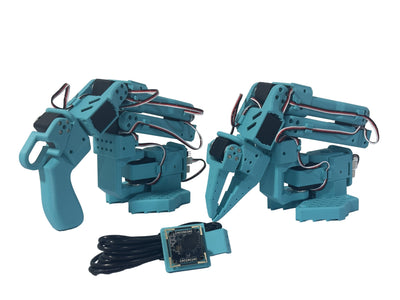
Hiwonder ArmPi Ultra ROS2 Robot Arm with Raspberry Pi5 Options
Hiwonder ArmPi Ultra ROS2 Robot Arm with Raspberry Pi5 Options
Hiwonder
수령 가능 여부를 로드할 수 없습니다.


Overview
The Hiwonder ArmPi Ultra is a programmable desktop robot arm for ROS2 education, vision-guided tracking, grasping and sorting. Its six smart bus servos and metal structure support manipulation experiments, while Raspberry Pi5 and STM32 divide higher-level processing and servo control. Choose the kit-specific camera and voice hardware, then select a version with or without Raspberry Pi5.3D perception requires the depth-camera configuration.
Features
- All-metal aluminum-alloy structure with anodized finish and bearing-supported base.
- Six intelligent bus servos with separate Raspberry Pi and STM32 control roles.
- App,PC software,Python and ROS topic/node control.
- Inverse kinematics,DH modeling,simulation and programmable vision tasks.
- Kit-dependent monocular/depth vision and Advanced voice-interaction hardware.
Software and Manipulation Functions
comprehensive tutorials
designed to inspire and support your AI-driven creative projects.
Depth Vision, 3D Scene Flexible Grabbing
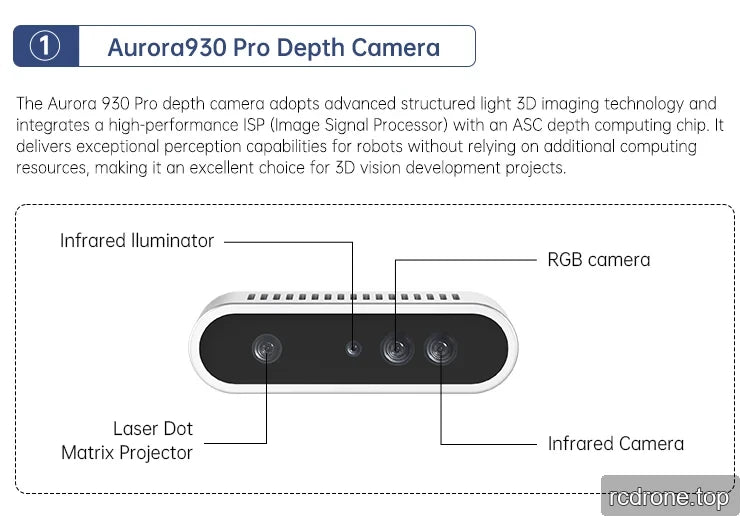
Depth-camera configurations support target recognition and tracking, RGB+D fusion detection, and object grasping in3D scenes.
All-metal Structure, Bearing Base
The body of the robot arm adopts an all-metal structure, and the anodized surface makes it exquisite and beautiful. The base uses industrial-grade bearings to meet high-demand grabbing projects.
Intelligent Bus Servo
ArmPi Ultra robotic arm body is equipped with 6 high-torque smart bus servos, allowing the robotic arm to grab heavy objects and run smoothly.
WonderEcho Pro AI Voice Box
The Advanced Kit includes a WonderEcho Pro AI voice box that delivers excellent noise reduction and clear audio capture. It supports advanced features such as speech recognition, voice broadcast, and voice control.
Dual-Controller Design for Efficient Collaboration
ArmPi Ultra combines the power of Raspberry Pi 5 with an STM32 controller to deliver smarter, faster, and smoother performance. Raspberry Pi 5 takes care of vision and decision-making, while STM32 ensures precise servo control and data process. Working together, they make the robot more responsive and capable than ever.
Function List
Large AI Model–Driven Embodied AI Applications
ArmPi Ultra integrates multimodal AI model for cross-modal perception, allowing seamless interaction across text, voice, and image, delivering richer and more creative user experiences.
Voice Control
Powered by ChatGPT, ArmPi Ultra can understand spoken commands and perform corresponding actions, delivering a natural and intuitive voice interaction experience.
Color Sorting
With the integration of ChatGPT and AI vision, ArmPi Ultra not only responds to voice commands but also accurately detects object colors within its field of view and sorts them automatically.
Waste Sorting
Built with the YOLO deep learning model, ArmPi Ultra can recognize different types of objects in its environment. With ChatGPT integration, it interprets user commands and executes tasks such as intelligent waste sorting.
3D Object Sorting
Equipped with a 3D depth camera, ArmPi Ultra detects objects of various shapes within its field of view. Combined with ChatGPT, it understands user instructions and performs the required sorting actions.
AI Embodied Intelligence Applications
Powered by high-performance hardware and multimodal large model, ArmPi Ultra can perceive and understand the environment, plan actions, and perform tasks with flexibility. It enables advanced human–robot collaboration and intelligent task handling, delivering a more natural and efficient interactive experience.
Real-Time Detection
Powered by ChatGPT, ArmPi Ultra understands user commands and analyzes scenes in real time. It provides instant feedback on image content and object features through both text and voice.
Vision Tracking
By combining ChatGPT with OpenRouter's visual large model, ArmPi Ultra interprets user commands to identify and locate objects. With inverse kinematics algorithms, it achieves precise and responsive target tracking.
Intelligent Transport
With the support of the Vision AI large model, ArmPi Ultra identifies target objects and retrieves their positional data. Combined with ChatGPT, it interprets user commands to transport objects to designated locations.
Smart Home Assistant
Powered by a multimodal large model, ArmPi Ultra recognizes and analyzes objects in its environment. Paired with ChatGPT, it understands user instructions and provides appropriate responses through both speech and actions.
Deep Learning Model Training
Custom object-detection models can be trained and deployed using suitable supported hardware and software. Hardware-specific acceleration requires a compatible deployment environment; no onboard NVIDIA GPU is included.
Waste Sorting
ArmPi Ultra robotic arm kit is equipped with garbage pattern blocks. By loading the corresponding model, ArmPi Ultra can quickly recognize different garbage and place it in the corresponding classification area.
Item Sorting
By training models of daily items and generating corresponding models, with the support of depth cameras, ArmPi Ultra can quickly recognize and grab corresponding items by obtaining the depth information of the items.
Gazebo Simulation
The ArmPi Ultra robotic arm is developed using the ROS framework and supports GAZEBO simulation. The robotic arm is controlled and algorithm verified in a virtual environment, which reduces the requirements for the experimental environment and improves experimental efficiency.
Applications
Develop color-sorting exercises,vision tracking,depth-guided pick-and-place and simulated manipulation experiments. Use depth-equipped kits for3D spatial tasks and Advanced hardware for voice-box activities. Network AI services require compatible accounts,connectivity and software configuration.
What's Included
One selected ArmPi Ultra kit and its kit-specific accessories. Starter uses a monocular camera; Standard includes depth vision; Advanced adds the WonderEcho Pro voice box. Raspberry Pi5 is included only when explicitly selected. Refer to the corresponding packing panel for the controller,leads,mounting hardware and learning accessories; demonstration computers are not included.
FAQ
Does every kit include a depth camera?
No. Starter uses a monocular camera; Standard and Advanced use depth cameras.
Is Raspberry Pi5 included?
Only options explicitly naming Raspberry Pi5 include the selected memory configuration.
Which kit includes the AI voice box?
The Advanced Kit includes the WonderEcho Pro voice-interaction box.
Configuration Guide
| Kit | Vision and voice configuration |
|---|---|
| Starter Kit | USB monocular camera; no3D depth camera or WonderEcho Pro voice box. |
| Standard Kit | Depth camera for3D perception; no WonderEcho Pro voice box. |
| Advanced Kit | Depth camera and WonderEcho Pro AI voice interaction box. |
The Raspberry Pi5 selection is independent of the kit: choose without Raspberry Pi5,or with2GB,4GB,8GB or16GB memory. A version without Raspberry Pi requires a compatible controller and software setup supplied separately.3D vision functions require the depth camera;voice-box functions require the Advanced Kit hardware and appropriate software/services.
Technical Specifications and Configuration References
| Aurora930 Pro Specifications | |||||
| Module parameter | Size | 76.5 × 20.7 × 21.8 mm | Imaging performance | Depth data format | 16-bit Raw |
| Baseline | 40mm | Depth resolution/Frame rate | 640×400 @12fps (FOV: 74°×51°) | ||
| Interface | USB 2.0 Wafer connector | RGB data format | NV12 | ||
| Depth accuracy | ±8mm @1m | RGB resolution /Frame rate | 640×400 @12fps (FOV: 74°×51°) | ||
| Working distance | 15–300 cm | IR data format | 8-bit Raw | ||
| Operating temperature | -10℃ to 55℃ | IR resolution /Frame rate | 640×400 @12fps (FOV: 74°×51°) | ||
| Operating humidity | 0% to 95% RH (non-condensing) | Firmware capabilities | Firmware upgrade | Supports USB OTA Update | |
| Operating illuminance | 3–80,000 Lux | Hot start delay | <300ms | ||
| Power supply | 5V±10%, 1.5A | System compatibility | OS compatibility | Linux / ARMv8 / ROS / Windows | |
| Power consumption | Average <1.6W | ||||
| Safety rating | Class 1 Laser safety |
| Aurora930 Pro Specifications | ||
| Module parameter | Size | 76.5 × 20.7 × 21.8 mm |
| Baseline | 40mm | |
| Interface | USB 2.0 Wafer connector | |
| Depth accuracy | ±8mm @1m | |
| Working distance | 15–300 cm | |
| Operating temperature | -10℃ to 55℃ | |
| Operating humidity | 0% to 95% RH (non-condensing) | |
| Operating illuminance | 3–80,000 Lux | |
| Power supply | 5V±10%, 1.5A | |
| Power consumption | Average <1.6W | |
| Safety rating | Class 1 Laser safety | |
| Imaging performance | Depth data format | 16-bit Raw |
| Depth resolution/Frame rate | 640×400 @12fps (FOV: 74°×51°) | |
| RGB data format | NV12 | |
| RGB resolution /Frame rate | 640×400 @12fps (FOV: 74°×51°) | |
| IR data format | 8-bit Raw | |
| IR resolution /Frame rate | 640×400 @12fps (FOV: 74°×51°) | |
| Firmware capabilities | Firmware upgrade | Supports USB OTA Update |
| Hot start delay | <300ms | |
| System compatibility | OS compatibility | Linux / ARMv8 / ROS / Windows |
| Product Parameters | |||
| Product | ArmPi Ultra | Size | 288*177*450mm |
| Weight | 1.47kg (Standard kit) | Controller | STM32F103RBT6 |
| Material | Full metal aluminum alloy bracket, sandblasted and anodized finish | Control methods | ROS topic/node control, Python program control, app control, PC software control |
| Power supply | 7.4V 6A DC | Storage | 64GB SD Card |
| Software | PC software + iOS / Android app | Communication | USB 2.0×2; USB3.0×2; serial port |
| Camera | USB Monocular Camera / Aurora Depth Camera | OS | RaspberryOS + Ubuntu 22.04 LTS (Docker) |
| Programming tools | Python /C/C++ /Javascript | Servo models | HTS-16L, HTS-25L, HX-06L, LX-15D, LX-225 intelligent bus servos |
| Tutorials | User manual, comprehensive tutorial, ROS source code, STM32 source code, system images, software | Packaging weight & dimensions | 3.2kg, 50x30x16cm; |
| Item | Specification |
| Product | ArmPi Ultra |
| Size | 288*177*450mm |
| Weight | 1.47kg (Standard kit) |
| Controller | STM32F103RBT6 |
| Material | Full metal aluminum alloy bracket, sandblasted and anodized finish |
| Control methods | ROS topic/node control, Python program control, app control, PC software control |
| Power supply | 7.4V 6A DC |
| Storage | 64GB SD Card |
| Software | PC software + iOS / Android app |
| Communication | USB 2.0×2; USB3.0×2; serial port |
| Camera | USB Monocular Camera / Aurora Depth Camera |
| OS | RaspberryOS + Ubuntu 22.04 LTS (Docker) |
| Programming tools | Python /C/C++ /Javascript |
| Servo models | HTS-16L, HTS-25L, HX-06L, LX-15D, LX-225 intelligent bus servos |
| Tutorials | User manual, comprehensive tutorial, ROS source code, STM32 source code, system images, software |
| Packaging weight & dimensions | 3.2kg, 50x30x16cm; |
Configuration Guide
The Raspberry Pi5 selection is independent of the kit: choose without Raspberry Pi5,or with2GB,4GB,8GB or16GB memory. A version without Raspberry Pi requires a compatible controller and software setup supplied separately.3D vision functions require the depth camera;voice-box functions require the Advanced Kit hardware and appropriate software/services.
Technical Specifications and Configuration References
Visual Details
Features and Design


Product Views


Specifications and Performance


Application Examples


Additional Product Details


Options and Model Comparison


Interfaces and Connections