Kunwei KWR46 Six-Axis Force/Torque Sensor, 46 mm, 50–500 N for Robotics
Kunwei KWR46 Six-Axis Force/Torque Sensor, 46 mm, 50–500 N for Robotics
Kunwei Sensing
Haikuweza kupakia upatikanaji wa kuchukua


Overview
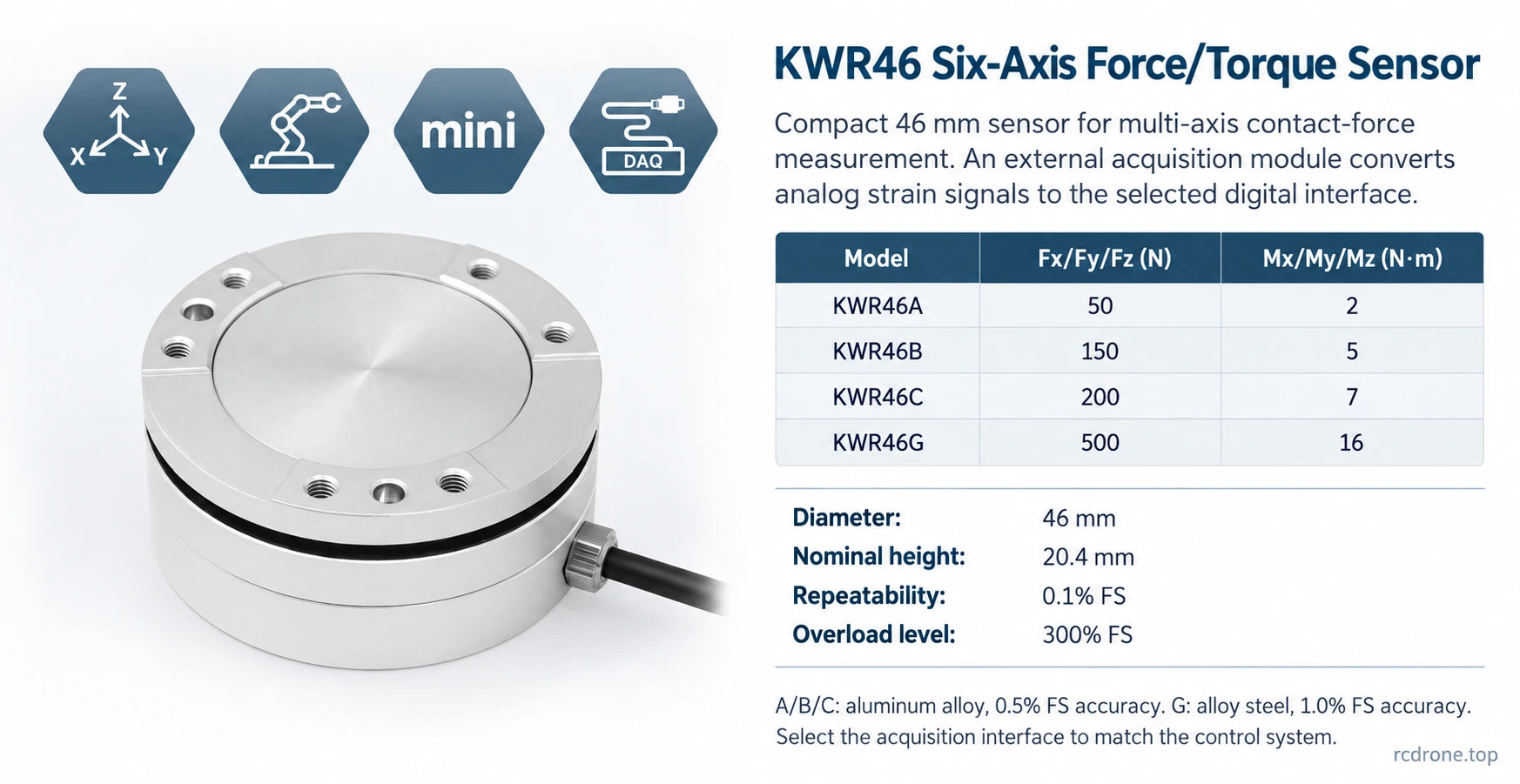
The Kunwei KWR46 six-axis force/torque sensor measures three forces and three moments for robotic contact-force control, precision assembly and compact test fixtures. Its 46 mm body is available in A, B, C and G models, with force capacities from 50 to 500 N and moment capacities from 2 to 16 N·m per axis. A matched external acquisition module processes the strain-gauge signals for the selected control interface.
Features
- Measures Fx, Fy, Fz and Mx, My, Mz for multi-axis load feedback.
- Compact 46 mm diameter and nominal 20.4 mm body height.
- Six-axis joint calibration, with 0.1% FS repeatability and model-specific accuracy.
- A/B/C models use anodized aluminum alloy; the higher-capacity G uses electropolished alloy steel.
- Multiple industrial communication choices through matched acquisition electronics.
- 300% FS overload level; working loads must remain within the rated measuring ranges.
Specifications
| Parameter | KWR46A | KWR46B | KWR46C | KWR46G |
|---|---|---|---|---|
| Range Fx, Fy (N) | 50 | 150 | 200 | 500 |
| Range Fz (N) | 50 | 150 | 200 | 500 |
| Range Mx, My (Nm) | 2 | 5 | 7 | 16 |
| Range Mz (Nm) | 2 | 5 | 7 | 16 |
| Diameter (mm) | 46 | 46 | 46 | 46 |
| Height (mm) | 20.4 | 20.4 | 20.4 | 20.4 |
| Material | Aluminum Alloy | Aluminum Alloy | Aluminum Alloy | Alloy steel |
| Surface Finish | Anodized | Anodized | Anodized | Electropolished |
| Overload Level (%FS) | 300 | 300 | 300 | 300 |
| Resolution (%FS) | 0.03 | 0.03 | 0.03 | 0.03 |
| Repeatability (%FS) | 0.1 | 0.1 | 0.1 | 0.1 |
| Accuracy* (%FS) | 0.5 | 0.5 | 0.5 | 1.0 |
| Weight (kg) | 0.06 | 0.07 | 0.07 | 0.21 |
| Protection Rating | IP64 | IP64 | IP64 | IP64 |
| Operating Temperature (°C) | −10 to +80 (sensor) | −10 to +80 (sensor) | −10 to +80 (sensor) | −10 to +80 (sensor) |
| Sampling Rate (Hz) | 1000 | 1000 | 1000 | 1000 |
| Matched acquisition module supply (VDC) | 9–24 default; 48 V requires a special configuration | 9–24 default; 48 V requires a special configuration | 9–24 default; 48 V requires a special configuration | 9–24 default; 48 V requires a special configuration |
| Communication Interface | Via matched acquisition module: RS422 / RS485 / Modbus / CAN / CAN FD / TCP / UDP / EtherCAT / USB; configuration dependent | |||
FS means full scale. Force and moment ratings are measuring capacities, not sensor mass or robot payload. Include tool weight, lever arms and combined loads when selecting a model. The 300% FS overload level does not extend the measuring range. Accuracy includes crosstalk, hysteresis and nonlinearity.
Body dimensions exclude the cable connector and other protrusions. Sensor body masses in this table are distinct from packed shipping weight. The force and moment ranges for G apply equally to its three force axes and three moment axes respectively.
Acquisition and Communication
The compact sensor requires an external acquisition module to convert analog strain-gauge signals into digital load data. The A/B/C/G selections specify measuring capacity, not a choice of communication protocol. Use acquisition electronics and a host interface matched to the required protocol; the listed interfaces are alternative configurations.
| Documented A/B/C serial acquisition | 24-bit ADC; 1 kHz sampling |
|---|---|
| Default module supply | 9–24 VDC; 48 V is not a default supply rating |
| Documented RS485 / RS422 module power | Less than 3 W |
| Serial settings | 460800 baud, 8 data bits, 1 stop bit, no parity |
| RS485 module reference | KWH06C80NL series; standard HDB15 sensor connection |
| Sensor-to-module connection | Dedicated multi-core cable; DB25 / HDB15 connection depending on the assembly |
| Documented serial module operating temperature | +5 to +80 °C; use this narrower limit for that complete setup |
| A/B/C drawing cable reference | 3 mm diameter, 5 m length; match the selected assembly |
The 24-bit ADC specification and 0.03% FS resolution describe different characteristics. Use the selected module's wiring and data-format instructions; the serial manuals use kg-based force and kg·m-based moment output conventions, so host software must apply the correct engineering-unit conversion rather than treating raw values as N and N·m. An RS422 unit connected using only the RS485 transmit pair can send data but cannot receive commands through that connection.
Applications
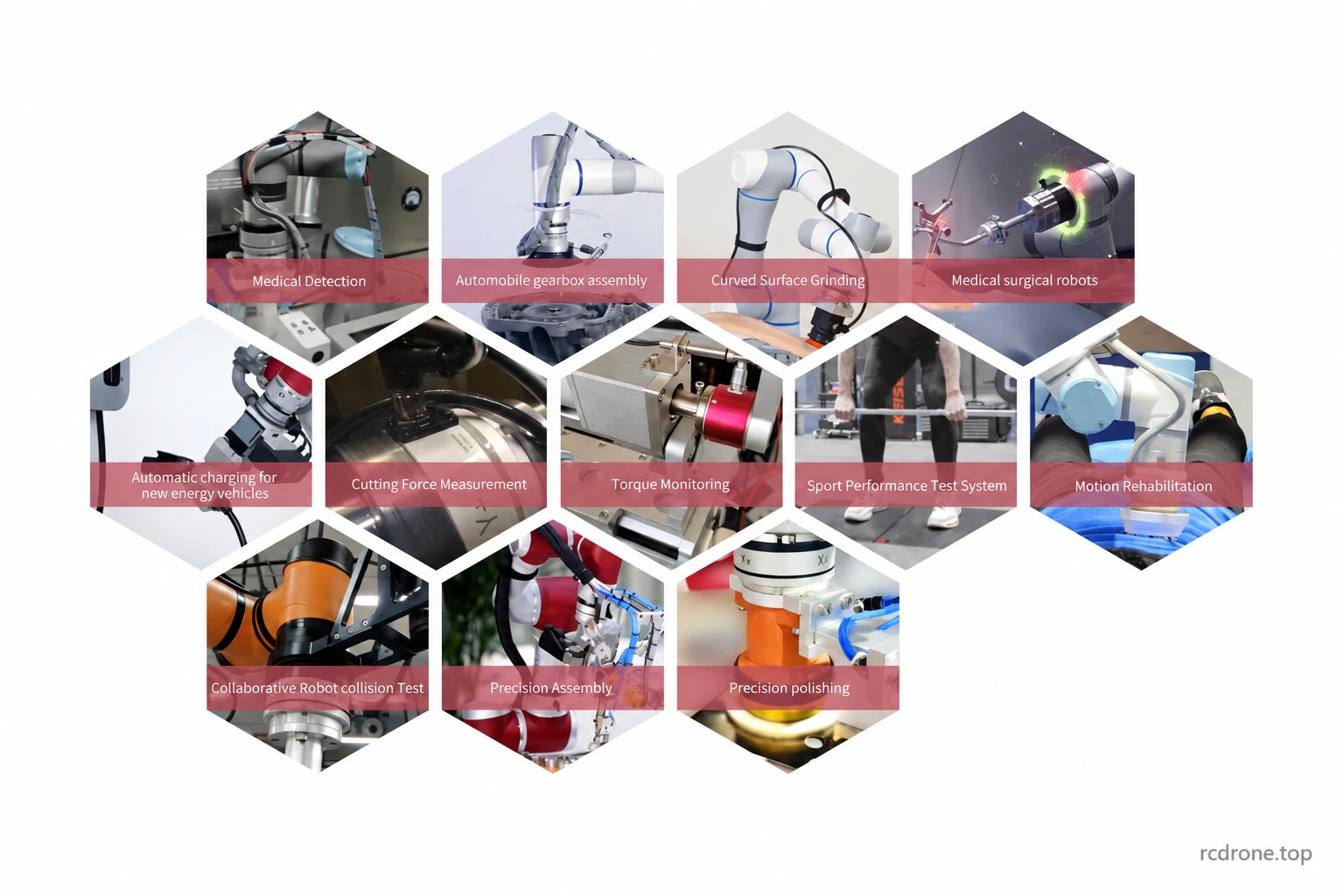
- Robotic insertion and assembly: measure contact forces and moments during part alignment and engagement, including gearbox assembly fixtures.
- Grinding and polishing: provide multi-axis feedback for developing contact-load control on curved surfaces.
- Machining and torque tests: monitor cutting forces or tool reactions within the selected six-axis load envelope.
- Robotics research: integrate compact force measurement into arms, humanoids, exoskeletons, quadrupeds and guided-vehicle tooling where the loads and mounting interface fit.
- Biomechanics and rehabilitation research: measure interaction loads in sports-test and assisted-motion fixtures.
Mechanical Installation and Setup
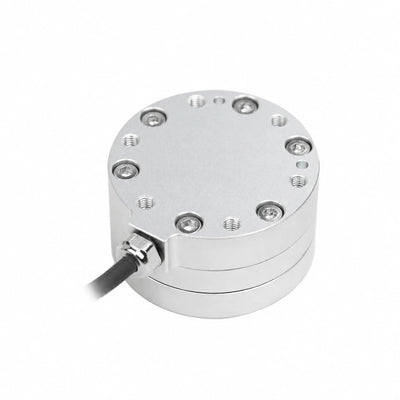
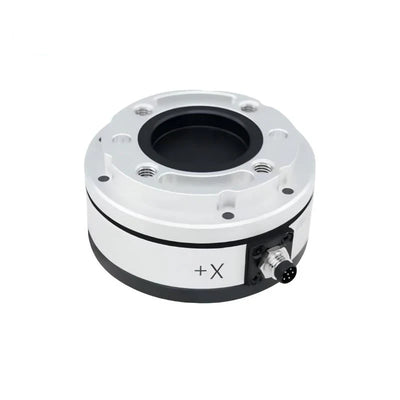
The mechanical reference shows a 46 ±0.05 mm body, a 39 ±0.05 mm mounting circle and six M3 attachment threads per face. The two faces have different thread-depth references: 3.5 mm and 5 mm. The drawing includes 3 mm locating-pin holes and face-specific angular offsets; match the correct face, orientation and screw engagement before making an adapter.
Keep mounting faces clean and flat, tighten screws progressively in a diagonal sequence, and do not open or strike the calibrated sensor body. Adapter flanges are not included by default. Proper face contact and cable-connector fastening are needed for IP64 protection. Verify power polarity before connection, allow warm-up according to the selected interface manual, and zero the installed system with its tool load accounted for.
What's Included
- 1 × Kunwei KWR46 sensor in the selected A, B, C or G model.
- Sensor connection cable and electronic documentation.
The documented RS485/RS422 A/B/C measurement packages also include one data acquisition module and a package box. The model selector alone does not specify the module protocol; the acquisition configuration for G must be established separately. USB/serial converters and DC power supplies are additional equipment. Robot arms, tools and application fixtures pictured in the visual examples are not included.
Downloads
- KWR46 mechanical drawing (PDF)
- KWR46 RS485 user manual (PDF)
- KWR46 RS422 user manual (PDF)
- Kunwei six-axis sensor selection manual (PDF)
FAQ
Which KWR46 model fits my load range?
A provides 50 N / 2 N·m, B 150 N / 5 N·m, C 200 N / 7 N·m and G 500 N / 16 N·m per corresponding axis. Check both forces and moments, including tool weight and lever-arm effects.
Can the sensor connect directly to EtherCAT, CAN or USB?
Digital communication requires the matching external acquisition module. Selecting A, B, C or G selects the load capacity, not every listed protocol.
Can I power the standard module from 48 V?
The default supply is 9–24 VDC. Use 48 V only with a specifically rated module configuration.
Is an acquisition module included?
The RS485/RS422 A/B/C package documentation lists one acquisition module. Establish the interface configuration for the selected model, particularly G; adapter flanges, USB converters and power supplies are not standard package items.
Do all KWR46 installation references use the same dimensions?
Use the drawing for the delivered revision: the nominal 20.4 mm reference has face-specific M3 engagement depths. An older RS422 document also contains different height and mass values, so those references must not be mixed when machining adapters.
Visual Details