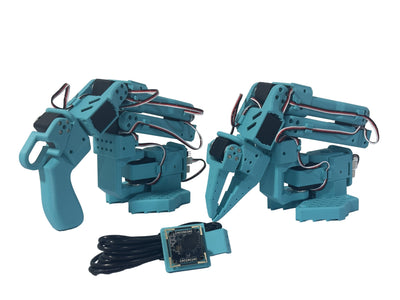
Hiwonder LeRobot SO-ARM101 Open-Source 6-Axis Leader-Follower Robotic Arm for VLA & Imitation Learning
Hiwonder LeRobot SO-ARM101 Open-Source 6-Axis Leader-Follower Robotic Arm for VLA & Imitation Learning
Hiwonder
Haikuweza kupakia upatikanaji wa kuchukua


Overview
The Hiwonder LeRobot SO-ARM101 is an open-source, 6-axis leader-follower robotic arm platform for embodied intelligence programming, imitation learning and VLA model development. Hugging Face LeRobot integration connects teleoperation and multimodal data collection with model training and deployment. Magnetic encoder bus servos provide position feedback, while a supported dual-camera configuration combines close-range and workspace perception. Choose the unassembled DIY Kit or assembled Starter, Standard and Advanced Kit options.
Features
Leader-Follower Teleoperation and Imitation Learning
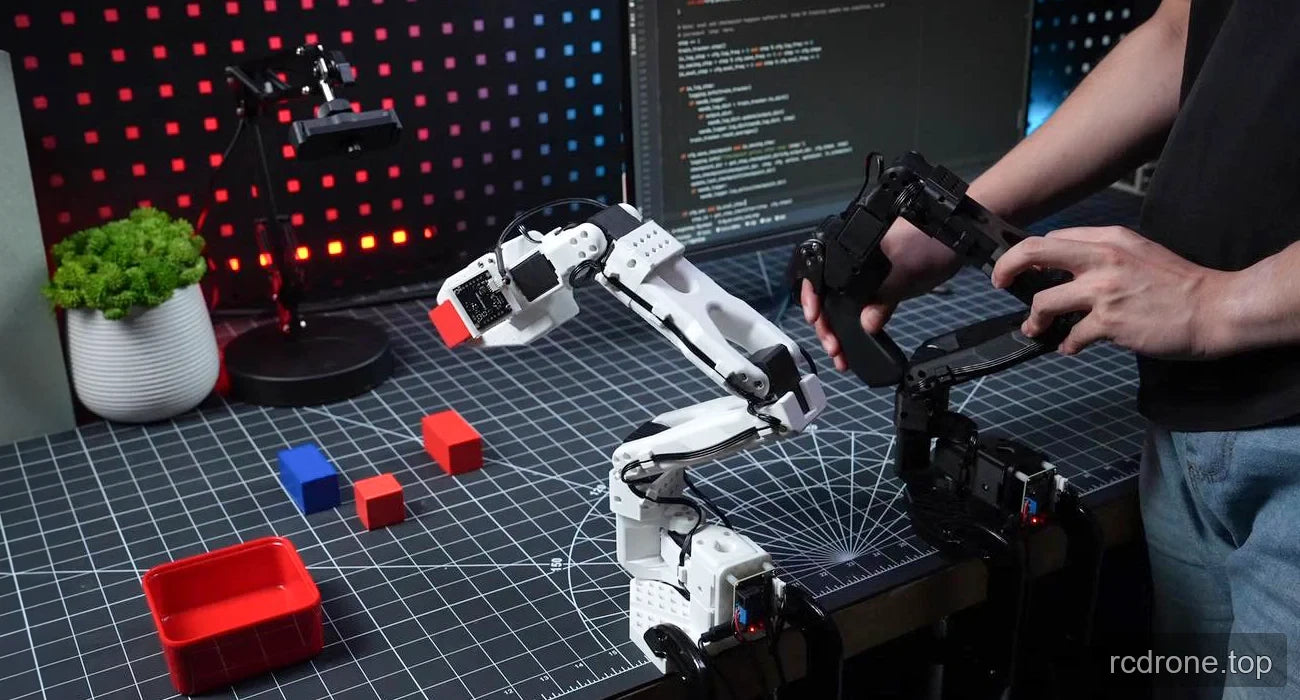
The leader-follower structure supports teleoperation, collaborative control and simultaneous collection of multimodal operation data. Demonstrated movements can become training data for learning object-grasping actions and motion trajectories.
- Collect demonstrations: guide the leader arm to control the follower and record multimodal operation data.
- Train models: upload data through the Hugging Face workflow and use its one-click imitation-model training process to convert demonstrations into learned skills. ACT model training and end-to-end multimodal VLA development are supported learning topics.
- Deploy and execute: use the supported single-click deployment workflow to run trained models on the arm for autonomous execution of learned actions and experiments in adapting tasks to environmental changes.
Dual-Camera Vision
The supported dual-camera configuration combines an arm-mounted camera with a separate camera on an adjustable desktop stand. These complementary viewpoints support AI vision, feature recognition and data collection.
- Primary Vision: the arm-mounted camera captures target position and surface texture at close range for hand-eye coordination and fine-grained feature data collection.
- Tertiary Vision: the external camera provides global workspace awareness, real-time environmental scanning and model construction for responding to external changes during task execution.
- Camera support: HD wide-angle imaging is supported. The Advanced Kit camera specifications and included mounting parts are listed separately below.
Magnetic Encoder Servos and Motion Control
The arm uses six self-developed magnetic encoder self-feedback bus servos, with IDs 1–6, a rotating base and articulated joints. Trapezoidal position control introduces acceleration and deceleration rather than direct position commands without ramping. A 12-bit magnetic angle sensor replaces mechanical potentiometer feedback and provides 360° encoder feedback.
The magnetic sensing design is described as compact and vibration-resistant, with reliability and service-life benefits. Different gearing serves the two arm roles: the main arm uses 1:147 gearing for fast response and fine control, while the follower arm uses 1:345 reduction for torque and positioning stability.
Structural Design and Materials
Distinct leader and follower structures use reinforced critical joints and load-bearing areas to reduce movement gaps and improve positioning precision. Optimized wiring and joint layouts reduce potential interference and motion lag. High-strength PLA structural components have strengthened, thickened key areas to improve fatigue resistance and resistance to deformation. Hardware refinements retain the project's open-source design and licensing approach.
BusLinker V3.0 PC Configuration
The Hiwonder BusLinker V3.0 servo debugging board works with dedicated PC software for servo scanning, parameter setup, status monitoring, trajectory control, and adjustment of motion and safety settings.
- Modular Management: one-click scanning generates a modular interface; dynamically configurable communication parameters and automatic baud-rate adjustment support centralized multi-servo control.
- Real-Time Parameter Feedback: high-frequency sampling and a real-time feedback engine monitor and visualize servo motion.
- Customizable Servo Settings: program motion modes and control logic, including control parameters, safety limits and feedback strategies.
Hugging Face LeRobot and Development Resources
Hugging Face LeRobot is an open-source robotics ecosystem with a Python library and model-sharing platform. Its tools, datasets and pretrained models support imitation-learning and reinforcement-learning development. The SO-ARM101 project makes mechanical designs, code, pretrained models and algorithm libraries available as open-source development resources.
SO-ARM101 integration supports direct use and deployment of LeRobot datasets, pretrained models and algorithms. Resources include a LeRobot tutorial library, the Hugging Face LeRobot Community, a GitHub repository and the Hugging Face LeRobot Model Hub. Step-by-step instruction covers setup through deployment, with access to updated algorithms and framework optimizations to keep development aligned with LeRobot updates.
Specifications
| Parameter | Specification or scope |
|---|---|
| Brand | Hiwonder |
| Model | LeRobot SO-ARM101 |
| Product type | Open-source leader-follower robotic arm platform |
| Axes | 6 |
| Servo arrangement | Six magnetic encoder self-feedback bus servos; IDs 1–6 |
| Servo supply | 12 V |
| Specified servo torque | 30 kg·cm at 12 V; also labeled “30KG” |
| Angle sensor | 12-bit magnetic angle sensor in place of a mechanical potentiometer |
| Encoder feedback | 360° magnetic encoder feedback |
| Position-control algorithm | Trapezoidal control with acceleration and deceleration |
| Main-arm gearing | 1:147 gear ratio |
| Follower-arm gearing | 1:345 reduction ratio |
| Servo protocol | SO-ARM101 servo protocol; LeRobot ecosystem integration |
| Mechanical arrangement | Rotating base, articulated joints and distinct leader/follower structures |
| Structural materials | High-strength PLA; reinforced and thickened key areas |
| Vision configuration supported | Arm-mounted Primary Vision and external, adjustable-stand Tertiary Vision |
| Learning and control support | Leader-follower teleoperation, multimodal data collection, end-to-end imitation learning, ACT training and multimodal VLA development |
| Development ecosystem | Hugging Face LeRobot; dedicated motion-control driver SDK |
Servo Bus Precaution
Do not use broadcast PING instructions when multiple servos are connected to the bus.
Kit Options
| Selection | Assembly state |
|---|---|
| DIY Kit / Unassembled | Unassembled |
| Starter Kit / Assembled | Assembled |
| Standard Kit / Assembled | Assembled |
| Advanced Kit / Assembled | Assembled; includes assembled 3D-printed components |
Applications
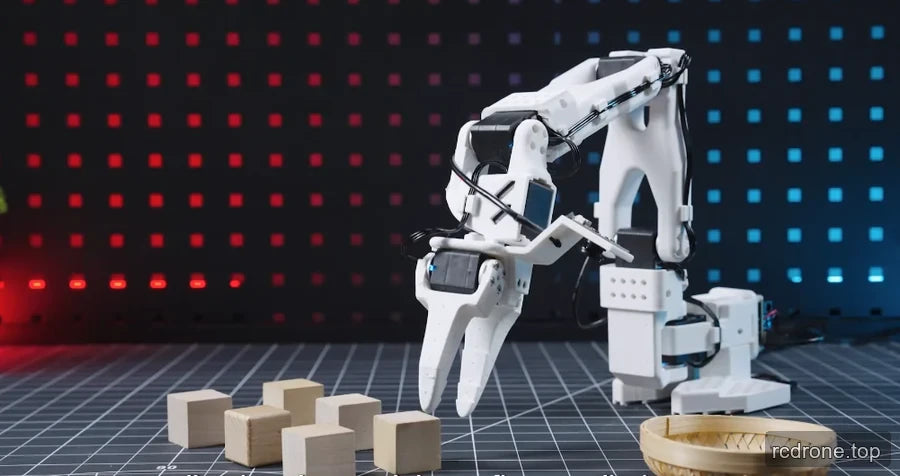
- Desktop manipulation experiments: demonstrate grasping colored or wooden blocks, handling geometric objects and sorting objects into bins or baskets, then use recorded demonstrations to develop learned actions.
- Vision-guided manipulation: combine close-range target and texture capture with an external workspace view to study hand-eye coordination and environmental perception.
- Imitation-learning and VLA research: collect leader-follower demonstrations, train policies and deploy learned behavior through the LeRobot workflow. The platform also supports exploration of reinforcement-learning methods.
- Robotics programming instruction: use hands-on arm demonstrations to teach control logic, motion trajectories and the connection between physical movement and an on-screen arm model.
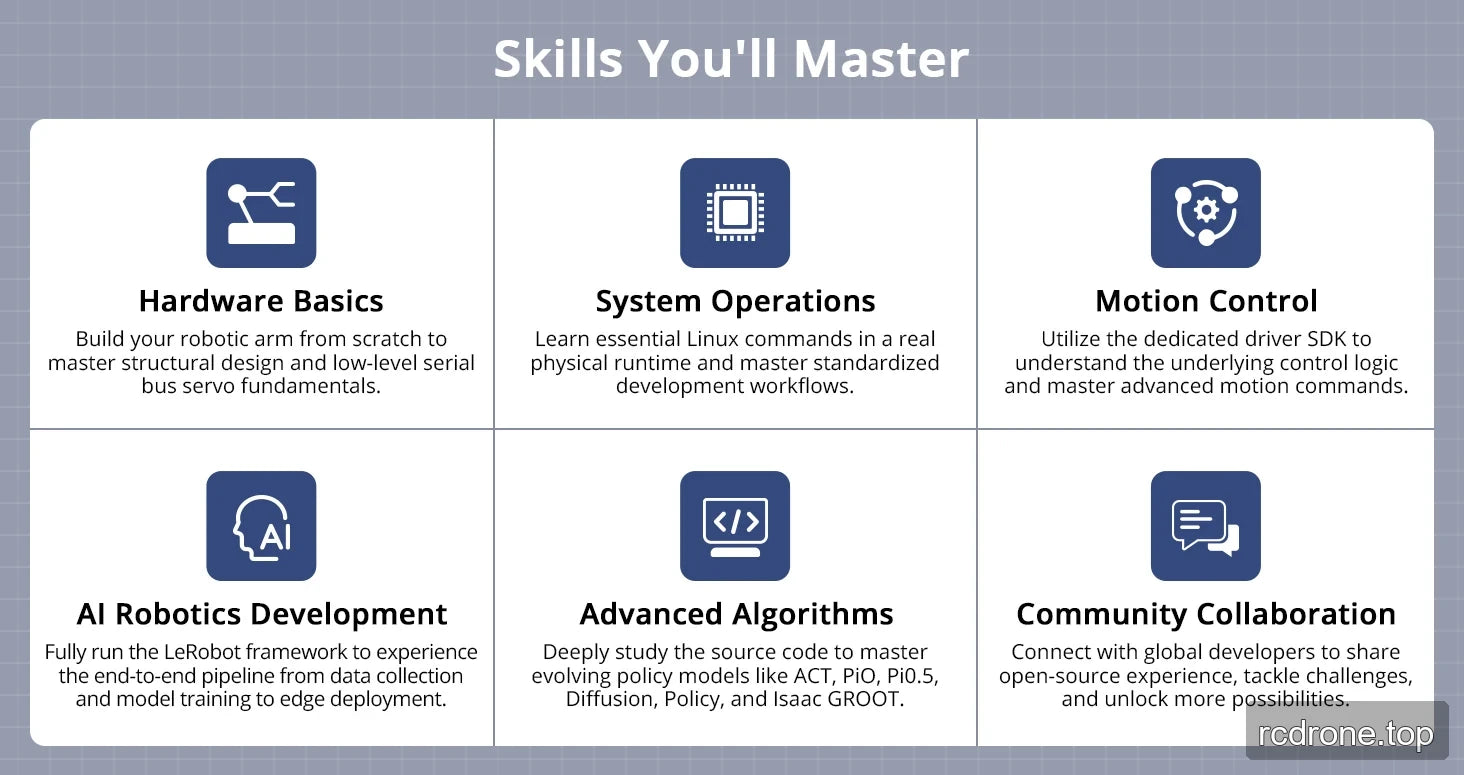
- Hardware and system learning: build the DIY arm from scratch while studying structural design and low-level serial bus servo fundamentals; practice essential Linux commands in a physical runtime and standardized development workflows.
- Motion-control development: use the dedicated driver SDK to study control logic and advanced motion commands.
- AI development and policy-code study: work through data collection, model training and edge deployment, with source-code study topics labeled ACT, Pi0, Pi0.5, Diffusion, Policy and Isaac GROOT.
- Open-source collaboration: share implementation experience and work on robotics development challenges with the LeRobot developer community.
What's Included
Advanced Kit / Assembled
The following packing list applies specifically to the Advanced Kit / Assembled option, which includes assembled 3D-printed components.
| Item | Quantity or supplied detail |
|---|---|
| SO-ARM101 leader arm | 1 |
| SO-ARM101 follower arm | 1 |
| USB hub | 4 ports; 1000 mm cable |
| Power adapters | 2; each 12 V, 5 A, with DC5.5 × 2.5 connectors |
| G-clamps | 4; 2-inch size |
| Type-C data cables | 2; 1000 mm each |
| Servo cables | 100 mm, 160 mm and 200 mm lengths |
| Metal main servo horns | 2 |
| Assistant servo horns | 2 |
| Cable ties | 3; 150 mm each |
| Screwdrivers | 2 |
| Accessory pack | Included |
| Camera mount | Included |
| 300K Pixel HD camera | Included |
| 2 MP HD wide-angle camera | Included |
| Black camera bracket | Included |
| White camera bracket | Included |
| USB data cables | 2; 1000 mm each |
FAQ
Which options require assembly?
The DIY Kit / Unassembled option requires assembly. The Starter, Standard and Advanced selections are labeled Assembled.
Does the Advanced Kit include both arms and cameras?
Yes. The Advanced Kit packing list includes an SO-ARM101 leader arm, follower arm, a 300K Pixel HD camera and a 2 MP HD wide-angle camera, together with the mounting parts listed above.
What is the difference between the two vision viewpoints?
Primary Vision uses an arm-mounted camera for close-range target capture and hand-eye coordination. Tertiary Vision uses an external camera on an adjustable stand for a global view of the workspace.
Does 360° encoder feedback mean every joint rotates continuously?
No continuous joint-rotation specification is provided. The 360° value describes magnetic encoder feedback, not a stated mechanical travel range for each joint.
What precaution applies when communicating with multiple servos?
Do not send broadcast PING instructions when multiple servos are connected to the bus.
Configuration Guide
| Kit | Assembly and vision equipment |
|---|---|
| DIY Kit / Unassembled | Unassembled hardware kit without 3D-printed structural components or vision cameras. Print the supplied structural designs before assembly; follow the DIY hardware packing list. |
| Starter Kit / Assembled | Assembled 3D-printed leader/follower components; no vision camera included. |
| Standard Kit / Assembled | Assembled arms and primary vision camera; no external scene camera. |
| Advanced Kit / Assembled | Assembled arms, primary vision camera and external scene camera with adjustable mount for dual-view data collection. |
3D-printed structural components are included with assembled kits. The kit-comparison and individual packing panels below define the accessories supplied with each selection. A depicted computer or demonstration workspace is not a supplied computer.
Technical Specifications and Configuration References
| Brand | Hiwonder | ||
| Product | SO-ARM101 Embodied Intelligent Open-Source Robotic Arm | ||
| Product material | PLA (Polylactic Acid) | ||
| Size | Leader arm: 111 × 239 × 525 mm | Follower arm: 111 × 173 × 532 mm | Camera mount: 166 × 258 × 527 mm |
| Weight | Leader arm: 697g | Follower arm: 704g | Camera mount: 1178g |
| Servo | HX-10HM bus servo ×6 | HX-30HM bus servo ×6 | / |
| Controller | BusLinker V3.0 Servo Debugging Board | ||
| Camera | 300K Pixel HD wide-angle camera (480P), 2MP HD wide-angle camera (1080P) | ||
| Power supply | 12V 5A (DC4.0*1.7) | ||
| Operating system | Windows / Ubuntu | ||
| Communication method | USB serial port | ||
| Programming tools | Python | ||
| Package Weight & Dimensions | DIY Kit: 5.23kg, 512 × 240 × 225 mm Starter Kit: 4.33kg, 512 × 240 × 225 mm Standard Kit: 4.38kg, 512 × 240 × 225 mm Advanced Kit: 5.6kg, 512 × 240 × 225 mm |
| Item | Specification | ||
| Brand | Hiwonder | ||
| Product | SO-ARM101 Embodied Intelligent Open-Source Robotic Arm | ||
| Product material | PLA (Polylactic Acid) | ||
| Size | Leader arm: 111 × 239 × 525 mm | Follower arm: 111 × 173 × 532 mm | Camera mount: 166 × 258 × 527 mm |
| Weight | Leader arm: 697g | Follower arm: 704g | Camera mount: 1178g |
| Servo | HX-10HM bus servo ×6 | HX-30HM bus servo ×6 | / |
| Controller | BusLinker V3.0 Servo Debugging Board | ||
| Camera | 300K Pixel HD wide-angle camera (480P), 2MP HD wide-angle camera (1080P) | ||
| Power supply | 12V 5A (DC4.0*1.7) | ||
| Operating system | Windows / Ubuntu | ||
| Communication method | USB serial port | ||
| Programming tools | Python | ||
| Package Weight & Dimensions | DIY Kit: 5.23kg, 512 × 240 × 225 mm Starter Kit: 4.33kg, 512 × 240 × 225 mm Standard Kit: 4.38kg, 512 × 240 × 225 mm Advanced Kit: 5.6kg, 512 × 240 × 225 mm |
Visual Details
Features and Design


Product Views

Application Examples

Additional Product Details




Specifications and Performance


Package Contents