Hiwonder NexArm ESP32 & AT32 AI Robotic Arm — K230 Vision and LeRobot Kit Options
Hiwonder NexArm ESP32 & AT32 AI Robotic Arm — K230 Vision and LeRobot Kit Options
Hiwonder
無法載入取貨情況


Overview
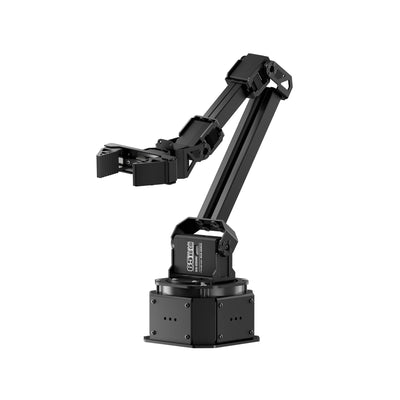
The Hiwonder NexArm is an open-source robotic arm for motion control, embodied AI and imitation-learning development. Its ESP32 and AT32 controller, magnetic-encoder bus servos and inverse-kinematics software support joint, Cartesian-coordinate and trajectory control. Choose Starter or Standard for the arm platform, Advanced for K230 vision and voice projects, or Ultimate for a leader–follower setup with dual external cameras and LeRobot learning equipment.
Choose Your Configuration
| Feature | Starter Kit | Standard Kit | Advanced Kit | Ultimate Kit |
|---|---|---|---|---|
| Follower arm; coordinate control and trajectory planning | Included | Included | Included | Included |
| App/PC control and ESP-NOW multi-arm projects | Supported | Supported | Supported | Supported |
| G clamps and adapter plate | Not included | Included | Included | Included |
| WonderMK K230 vision module, speaker and mounting parts | Not included | Not included | Included | Included |
| Leader arm for synchronized control and demonstration collection | Only with leader add-on | Only with leader add-on | Only with leader add-on | Included |
| 0.3 MP first-view and 2 MP external-view cameras, camera mount and PS3 controller | Not included | Not included | Not included | Included |
| Imitation-learning collection/training equipment | Requires additional equipment | Requires additional equipment | Requires additional equipment | Included kit hardware; training computer required |
Choose an accessory only from the combinations offered in the selectors: a leader arm, suspension mecanum chassis, motorized sliding rail or conveyor belt. The selected accessory is additional to the base kit. Ultimate already includes a leader arm and has no separate leader-arm add-on selection. Chassis, rail and conveyor are optional and are not included with “No Extra Accessories”.
Features
- Metal arm frame with five arm axes plus gripper actuation, giving six servo-driven degrees of freedom.
- Dual-output-shaft bus servos with metal gears and magnetic angle feedback; key magnetic-encoder joints use 12-bit feedback.
- Trapezoidal acceleration/deceleration, continuous interpolation and motion smoothing for coordinated starts, stops and path planning.
- Parallel-rail gripper with silicone pads and stainless-steel transmission components; bearing-supported base with a 270° illustrated rotation range.
- Visual PC software with action-group editing, coordinate control, 3D visualization, PID tuning and real-time servo monitoring.
- USB serial, Bluetooth and Wi-Fi control, plus ESP-NOW collaborative-control development with unicast, multicast and broadcast modes.
- Advanced and Ultimate add K230 machine vision, command-based voice interaction and configured multimodal-model applications.
- Ultimate supplies leader–follower and dual-camera hardware for demonstration collection, model training and policy-deployment projects.
Motion Control and Programming
Control individual joints, enter 3D coordinates and end-effector pose parameters, or build motion sequences frame by frame using sliders and numerical input. Inverse-kinematics interfaces calculate servo angles for target coordinates within the reachable workspace. Linear motion, three-dimensional path planning and adaptive grasp orientation support hand–eye coordination when the required vision hardware is fitted.
The PC interface mirrors the arm in 3D and provides system settings for app and wireless-controller operation, servo speed, torque, acceleration and PID parameters. Configure overload limits and torque thresholds, read servo status, edit action groups and invoke or delete stored actions. Voltage, position, angle, speed and torque-threshold feedback support adjustment and diagnostics. Dynamic external-force adaptation unloads the affected joint under a strong external force and returns to position after release; it does not establish a collaborative-robot safety rating.
Develop custom programs with Arduino IDE using the open source code, schematics, examples and kinematics interfaces. Windows, Linux and macOS are listed host operating systems; individual software tools and training environments have their own setup requirements. App control provides per-joint movement, sorting and preset action groups. PS3 wireless-controller operation requires the controller, included with Ultimate.
Vision, Voice and Embodied AI
Advanced and Ultimate include the WonderMK K230 module with a 2MP camera, 2.4-inch capacitive touchscreen, microphone and 6 TOPS equivalent computing capability. More than 30 vision functions cover color identification and sorting, color/target tracking, face recognition, gesture control, AprilTag localization and stacking, OCR and YOLO-based detection. Program recognized targets to trigger actions or combine target coordinates and orientations with inverse kinematics for grasping.
Use the visual interface and supported one-click training workflow to build recognition projects. Voice and vision examples include object tracking, spoken multi-step handling tasks, scene-aware dialogue and sorting labeled blocks. Online large-model requests require network access, compatible firmware and configured service credentials. The module supports Alibaba Bailian API integration and projects using models such as DeepSeek, Qwen, StepFun, Llama, 01.AI and Gemini; service availability and setup depend on the provider. Voice command wake-up is distinct from online dialogue.
LeRobot and Imitation Learning
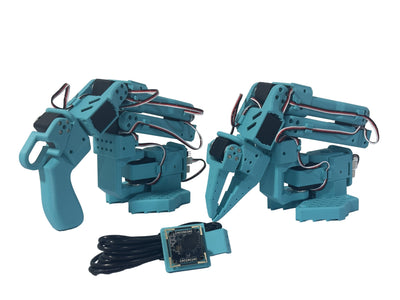
With a leader and follower arm, teleoperate the follower through demonstrations and collect synchronized multimodal samples. Ultimate includes the leader arm, a close-range first-view camera and a separate global-view camera with mount. Use demonstration data with Hugging Face LeRobot resources, pretrained models, datasets and simulation tools to develop ACT or VLA workflows, train a policy and deploy it for autonomous execution.
The leader arm uses a 1:147 gear ratio; the follower uses 1:345 for higher reduction and positioning stability. Close-range vision records object position, orientation and surface detail, while the external camera covers the workspace. Model training and inference require a suitable host, such as the specified Raspberry Pi/NVIDIA development platform or a PC with a dedicated GPU, together with the appropriate environment; these computers are not supplied. Offline drag teaching and synchronized leader–follower motion require a leader arm and the appropriate control setup.
Specifications
Arm and Kit Parameters
| Parameter | Specification |
|---|---|
| Product | NexArm open-source embodied AI robotic arm |
| Frame | Metal |
| Degrees of freedom | 5DOF arm + gripper; 6 servo-driven axes |
| Follower arm dimensions | 111 × 111 × 614 mm, upright reference |
| Follower arm mass | 1.3 kg |
| Leader arm dimensions | 111 × 216 × 619 mm, product-table reference |
| Leader arm mass | 1.2 kg |
| Follower servo installation | 2 × HX-12H + 3 × HX-30HM + 1 × HX-65HM |
| Leader servo installation | 5 × HX-10HM + 1 × HX-12H |
| Power supply | 12 V, 5 A; DC 5.5 × 2.5 mm connector |
| Host operating systems | Windows / Linux / macOS |
| Control interfaces | USB serial / Bluetooth / Wi-Fi |
| Programming tool | Arduino IDE |
| Repeatability reference | ±2 mm |
| Drawing rotation references | Base 270°; illustrated shoulder/elbow/wrist references 240°, 270°, 200° |
| Follower drawing references | Full upright height 614 mm; base width 111 mm; base height 110 mm; upright sections 225 / 145 / 130 mm; gripper width 51 mm; bent-pose offset 143 mm; bent-pose base height 97 mm |
| Leader drawing references | Full upright height 619 mm; base side 122 mm; depth 211 mm; upright sections 110 / 225 / 145 / 65 / 74 mm; bent-pose offsets 132 / 132 mm; bent-pose base height 69 mm |
| Starter package | 2 kg; 345 × 158 × 220 mm |
| Standard package | 3.2 kg; 345 × 158 × 220 mm |
| Advanced package | 3.3 kg; 345 × 158 × 220 mm |
| Ultimate package | 8 kg; 487 × 290 × 195 mm |
Arm dimensions vary with pose. The leader product-table envelope (111 × 216 × 619 mm) and the drawing base references (122 and 211 mm) describe different references; use the full drawing for mounting rather than treating the table envelope as a base-hole layout. Package masses are technical references and do not replace store shipping-weight settings. Servo stall torque is not an arm payload rating.
Installed Servo Model References
| Model | Rotation speed | Stall torque | Specified servo accuracy |
|---|---|---|---|
| HX-10HM | 0.10 s/60° at 11.1 V | 10 kg·cm at 11.1 V | 0.3° |
| HX-12H | 0.20 s/60° at 11.1 V | 12 kg·cm at 11.1 V | 0.3° |
| HX-30HM | 0.19 s/60° at 11.1 V | 30 kg·cm at 11.1 V | 0.3° |
| HX-65HM | 0.19 s/60° at 11.1 V | 65 kg·cm at 12.6 V | 0.3° |
All four listed models support readback, temperature/voltage/position feedback, stall protection and overtemperature protection. Speed and stall-torque conditions are separate as listed. The nominal 12 V arm supply does not make the 12.6 V servo stall-torque test a guaranteed operating payload.
Follower Arm Controller
| Parameter | Specification |
|---|---|
| Main processor | ESP-WROOM; 32-bit dual-core Xtensa LX6 |
| Main clock | ≤240 MHz |
| ROM / SRAM | 448 KB / 520 KB |
| Wi-Fi / Bluetooth | Supported |
| Communications | UART, I2C, Wi-Fi, Bluetooth |
| Peripheral resources | Wi-Fi/Bluetooth, 12-bit ADC, UART, I2C, 4 × 64-bit general-purpose timers and 64-bit high-precision timer |
| Programming environment | Arduino IDE |
| Input | 12 V, 5 A |
| Main flash | 4 MB |
| Secondary processor | AT32F421F8P7; 32-bit ARM Cortex-M4 |
| Secondary clock / flash | ≤120 MHz / 64 KB |
| Interfaces | Type-C, UART, I2C, bus servo ports, display and button port |
| OLED | 0.96 inch; 128 × 64 pixels |
| Custom buttons | 2 |
| Bus servo ports | 4 total: 2 × 5264 and 2 × PH2.0 |
| I2C ports | 3 |
| Buzzer | PWM frequency output supported |
| Power output | Type-C 5 V, 5 A |
Leader Arm Controller
| Parameter | Specification |
|---|---|
| Main processor | ESP-WROOM; 32-bit dual-core Xtensa LX6 |
| Main clock | ≤240 MHz |
| ROM / SRAM | 448 KB / 520 KB |
| Wi-Fi / Bluetooth | Supported |
| Communications | UART, I2C, Wi-Fi, Bluetooth |
| Peripheral resources | Wi-Fi/Bluetooth, 12-bit ADC, UART, I2C, 4 × 64-bit general-purpose timers and 64-bit high-precision timer |
| Programming environment | Arduino IDE |
| Input | 12 V, 5 A |
| Interfaces | Type-C, UART, I2C, bus servo ports and joystick |
| Bus servo ports | 2 total: 1 × 5264 and 1 × PH2.0 |
| Buzzer | PWM frequency output supported |
| Reserved ports | I2C and 2 GPIO ports |
| Onboard controls | Power switch, LED indicator and chassis remote-control joystick module |
WonderMK K230 Module
| Parameter | Specification |
|---|---|
| Processor | Canaan K230 |
| Equivalent computing capability | 6 TOPS |
| Dimensions / mass | 74 × 19 × 49 mm / 55 g |
| Camera / field of view | 2MP / 80° |
| Screen | 2.4-inch LCD capacitive touchscreen |
| RAM | 1 GB LPDDR4 |
| Voice wake-up | Command wake-up |
| Voice-recognition distance | Up to 5 m in quiet settings; 1 m in noisy environments |
| Operating supply | USB Type-C, DC 5 V |
| Wi-Fi | 802.11 b/g/n |
| Development tools | MicroPython, CanMV IDE |
| Interfaces | Speaker, I2C, Type-C, serial, GPIO and TF card slot |
| Onboard features | Microphone, buzzer, RGB LED, reset button and back button |
| Integration | STM32/Raspberry Pi and mainstream development ecosystems; built-in visual interface and one-click training |
Ultimate External Camera Pair
| Parameter | First-view camera | External/global-view camera |
|---|---|---|
| Image sensor | GC0308 | GC2083 |
| Resolution | 0.3 MP | 2 MP |
| Output | 640 × 480 | 1920 × 1080 MJPG; 640 × 480 YUYV |
| Aperture | f/2.2 | f/2.2 |
| Focal length | 3.6 mm | 3.42 mm |
| Field of view | 120° | 160° |
| Distortion | −25% | Not specified |
| Maximum frame rate | Not specified | 30 fps |
| Dimensions | 30 × 27 × 24 mm | 30 × 27 × 20 mm |
| Focus / installation | Manual focus, plug-and-play USB camera | Manual focus, plug-and-play USB camera |
Learning Topics
Projects progress from arm-control fundamentals to vision and model-based tasks. Camera, K230, leader-arm and host-compute requirements follow the configuration and project used.
Robotic arm fundamentals
Arm structure; Single- and multi-servo control; Servo status readout; Serial/Wi-Fi communication; App, wireless-controller and PC control; Gripper control.
Embedded development
ESP32 environment setup; Button/buzzer control; OLED display; ADC voltage sampling; Flash file system; Wi-Fi programming.
Kinematics
Forward kinematics; Inverse kinematics; Coordinate/joint mapping; Kinematics-based control; Velocity planning and trajectory control.
Action editing
Action-group editing; Execution; Invocation; Offline execution; Offline deletion; Drag teaching; Motion optimization; Fixed-point grasping; Transport and sorting; Automated process control.
Vision and AI
Color recognition/sorting; Color and target tracking; AprilTag localization; AprilTag grasping/stacking; Face recognition/tracking; Gesture control; Multimedia applications; OpenMV recognition; OCR; Model training/deployment.
Large-model projects
Model integration; Speech recognition; Speech synthesis; Voice control; Multimodal integration; Speech/vision interaction; Scene understanding; Decision making; Intelligent grasping; Autonomous execution.
Applications
- Desktop robotics teaching: compare direct joint control, Cartesian targets and inverse-kinematics trajectories.
- Vision-guided sorting: use Advanced or Ultimate to recognize colors, tags and targets, then calculate grasp orientation and placement.
- Imitation-learning research: collect leader–follower demonstrations with Ultimate and develop LeRobot policies using a suitable training computer.
- Embodied-AI prototypes: connect configured voice and vision requests to object tracking, handling and scene-understanding actions.
- Automation demonstrations: add the selected conveyor, linear rail or suspension mecanum chassis for transport and expanded-workspace experiments.
What's Included
| Selection | Contents |
|---|---|
| Starter Kit | Assembled follower arm; 12 V 5 A DC 5.5 × 2.5 mm power adapter; 1000 mm Type-C cable; 200 mm module/servo cables; screw pack and screwdriver; user manual |
| Standard Kit | Starter contents plus G clamps and adapter plate |
| Advanced Kit | Standard contents plus WonderMK K230 vision module and mounting bracket, speaker, card reader, cable ties and 1000 mm module cable |
| Ultimate Kit | Advanced contents plus assembled leader arm, all-metal camera mount, 0.3 MP camera and bracket, 2 MP camera and bracket, PS3 wireless controller, 200 mm servo cables, 4-port USB hub with 1000 mm cable, 3 × 1000 mm USB data cables, 12 × M4 × 6 machine screws and 10 × M2 × 4 machine screws |
| Leader-arm add-on | Assembled leader arm, G clamps, adapter plate, 12 V 5 A adapter, 1000 mm Type-C cable, 200 mm module/servo cables, screw pack and manual |
| Sliding-rail add-on | Assembled motorized sliding rail, adapter plate and screw pack |
| Conveyor add-on | Assembled electrical conveyor belt, baffle plate and screw pack |
| Chassis add-on | Assembled suspension mecanum chassis, adapter plate, screw pack, 12.6 V 2 A adapter with DC 5.5 × 2.5 mm plug and 250 mm power cable |
One selected base kit and any selected accessory are supplied. Computers, phones, extra arms outside the selected package, display scenery and demonstration objects are not included. The arm requires the specified external power supply; there is no included robot battery listed.
FAQ
Which kits include K230 AI vision and voice hardware?
Advanced and Ultimate include WonderMK K230, its mounting bracket and speaker. Starter and Standard provide the arm platform without that module.
What does Ultimate add for LeRobot projects?
Ultimate adds a leader arm, two external cameras with mounting equipment, a PS3 controller and USB accessories. Training and deploying imitation-learning policies still requires a suitable host computer and software setup.
Does every kit include a leader arm or mobile chassis?
Ultimate includes a leader arm; Starter, Standard and Advanced offer it as a selected add-on. Chassis, sliding rail and conveyor are separate accessory selections, not standard contents.
Is 65 kg·cm the arm payload?
No. It is the HX-65HM servo stall-torque reference at 12.6 V. It does not specify the load that the complete arm can lift at a given reach.
Can voice dialogue work without an online service?
Command wake-up and local vision are distinct from cloud model dialogue. Online multimodal requests need network access, suitable firmware and the corresponding configured service.
Visual Details
Vision and voice demonstrations use K230-equipped Advanced or Ultimate. Leader–follower and external-camera scenes require the relevant equipment. Expansion devices shown separately are included only when selected.