Hiwonder MechDog AI ESP32 Open-Source Robot Dog — Standard & 3DOF Arm Kits
Hiwonder MechDog AI ESP32 Open-Source Robot Dog — Standard & 3DOF Arm Kits
Hiwonder
Abholverfügbarkeit konnte nicht geladen werden


Overview
The Hiwonder MechDog AI is an ESP32 open-source quadruped robot dog for learning gait control, inverse kinematics and multimodal AI interaction. Its aluminum-alloy body uses eight servo-driven leg joints and IMU feedback for posture and balance experiments. Both Standard and Advanced kits include the ESP32-S3 WonderLLM camera, display and audio module. Choose Advanced to add a 3DOF arm for grasping and transport projects.
Choose Your Kit
| Feature | Standard Kit | Advanced Kit |
|---|---|---|
| Eight-joint quadruped body and WonderLLM module | Included | Included |
| App and PC serial control | Supported | Supported |
| Ultrasonic ranging and obstacle-avoidance projects | Supported | Supported |
| Real-time Wi-Fi video | Supported | Supported |
| Offline AI vision and voice interaction | Supported with appropriate firmware | Supported with appropriate firmware |
| Online large-model interaction | Supported with network/service setup | Supported with network/service setup |
| 3DOF arm and intelligent transport | Not included | Included |
Standard is the walking and AI-interaction platform without the robotic arm. Advanced adds three arm joints to the eight body joints. Grasping, pick-and-place and voice-directed object transport demonstrations require Advanced; full-feature photos show that configuration.
Features
- Hard aluminum-alloy structure with metal leg linkages and eight HPS-0618SG coreless servos.
- Inverse-kinematics gait control with adjustable stride length, step frequency, direction, roll, pitch and body height.
- QMI8658 six-axis IMU for posture sensing and closed-loop balance adjustment.
- WonderLLM ESP32-S3 module with a 2MP wide-angle camera, 2.0-inch capacitive touchscreen, microphone and speaker.
- App control, visual PC coordinate control and action-group editing, plus Scratch, Arduino and MicroPython programming.
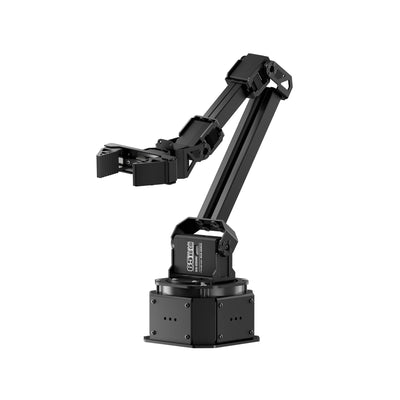
- Advanced Kit adds a lightweight three-axis arm with three LFD-01M micro servos and a gripper opening up to 147 mm.
- Rechargeable 7.4 V 1500 mAh 5C battery with built-in protection and an included 8.4 V 2 A charger.
Vision, Voice and Large-Model Interaction
Flash the dedicated vision firmware to run color recognition, color/target tracking and face detection locally. These offline vision functions do not require an internet connection; Wi-Fi video streaming provides a live camera feed. Offline command-based voice interaction uses the module's voice processor and configured wake/command words.
For online multimodal projects, WonderLLM integrates text, voice and vision services such as DeepSeek, Qwen3 and Doubao. Applications include dialogue, question answering, scene and object understanding, spoken instructions, image analysis and intent interpretation. Network access, compatible firmware and the relevant platform/service configuration are required for online model requests.
Customize the assistant's personality, voice tone, memory settings and behavior logic. The voice platform supports over 30 dialogue languages and configurable wake words, command words and broadcast phrases. Example projects explore conversational tone responses, weather queries, encyclopedia questions and combined voice/vision feedback.
IMU readings can be used to distinguish standing and sitting states, while camera/model projects can trigger responsive actions in a watchdog-style demonstration. Advanced adds visually guided pick-up, gripper control, app-directed delivery and voice-controlled transport. These are programmable learning applications rather than a rated security or industrial handling system.
Motion, Gait and Control
The eight-joint body supports multidirectional walking, in-place turning and real-time posture changes. Adjust stride length and frequency to change walking speed, vary pitch and roll, and switch between high and low stances. Synchronized posture and center-of-gravity changes enable pitch-angle walking and adaptive movement experiments. Six-axis IMU feedback adjusts leg joints in a closed loop for balance.
The visual PC software provides joint, coordinate and posture control. Drag coordinate points to issue end-effector position commands, and set step parameters in the action editor to build and run coherent action groups without writing code. Open kinematics APIs support deeper custom motion development.
The Android/iOS app provides a direction joystick, action-group buttons, pitch/roll adjustment and a body-height slider. Its interface includes settings, battery-voltage display, Bluetooth switching and video-feed controls. Multi-robot control is a supported development topic; additional robots are not included in one kit.
Specifications
Robot and Kit Dimensions
| Product | MechDog AI |
|---|---|
| Main control | ESP32 dual-mode SoC with a 32-bit ARM multifunction controller |
| Body material | Hard aluminum alloy with metal leg linkages |
| Body degrees of freedom | 8DOF, both kits |
| Arm degrees of freedom | Additional 3DOF, Advanced Kit only |
| Standing dimensions — Advanced | 269 × 126 × 174 mm, powered on and standing |
| Powered-off dimensions — Advanced | 282 × 124 × 127 mm |
| Drawing height references — Advanced | Standing side references: 124 mm and 78 mm; powered-off side references: 80 mm and 34 mm |
| Product mass — Advanced | 711 g |
| Package dimensions — Advanced | 349 × 164 × 135 mm |
| Package mass — Advanced | Approximately 1.16 kg |
| Leg servos | 8 × HPS-0618SG high-performance coreless servo |
| Arm servos — Advanced | 3 × LFD-01M micro servo |
| Control/software | PC control and action-editing software; Android/iOS app |
| Programming | Scratch, Arduino and MicroPython |
| Battery | 7.4 V nominal, 1500 mAh, 5C Li-ion battery |
Standing and powered-off dimensions describe different body poses. Product and package masses are technical references, separate from the store’s shipping-weight settings. Advanced arm dimensions and mass do not establish the same measurements for Standard.
ESP32 Main Controller
| Power input | 6–8.4 V |
|---|---|
| PWM servo ports | 11 channels, grouped 7 + 2 + 2 |
| GPIO port | 1 channel |
| Custom button | 1 |
| Mounting-hole spacing | 72 × 12 mm |
| IMU | QMI8658; 3-axis accelerometer and 3-axis gyroscope |
| I2C ports | 4 channels |
| Buzzer | 1 |
| Three-pin power port | 1 |
| Board dimensions | 79 × 53 mm |
| Other controls | Charging port and power switch; ESP32 core board connection |
| Servo command interface | Serial commands via the 32-bit ARM multifunction controller |
WonderLLM AI Vision and Voice Module
| Controller chip | ESP32-S3 |
|---|---|
| Camera | 2MP |
| Field of view | 123° |
| Voice chip | CI1302 |
| Display | 2.0-inch LCD capacitive touchscreen |
| Voice-recognition mode | Command wake-up |
| Supply | USB Type-C, 5 VDC |
| Communication | I2C |
| Onboard resources | Microphone, speaker, mode-switch button and wake-up button |
| SPI flash | Up to 16 MB |
| RAM | 512 KB internal; 16 MB external PSRAM |
| Wi-Fi | 802.11 b/g/n |
| Bluetooth | Bluetooth 5 and Bluetooth Mesh |
| Voice-recognition distance | Up to 5 m in quiet environments; 1 m in noisy environments |
| Dimensions | 60 × 22 × 54 mm |
| Mass | 46 g |
Servo Comparison
| Parameter | HPS-0618SG leg servo | LFD-01M arm servo |
|---|---|---|
| Installed quantity | 8, both kits | 3, Advanced only |
| Rotation speed | 0.06 s/60° at 8.4 V | 0.12 s/60° at 6 V |
| Stall torque | 8 kg·cm at 8.4 V | 1.8 kg·cm at 6 V |
| Motor | Coreless motor | Coreless motor |
| Rotation range | 0–180° | 0–180° |
| Control | PWM pulse-width control | PWM pulse-width control |
| Gear reference | Stainless-steel gears | Metal gears |
Battery and Charger
| Type | Li-ion rechargeable battery with protection board |
|---|---|
| Capacity | 1500 mAh |
| Discharge rate | 5C |
| Nominal / fully charged voltage | 7.4 V / 8.4 V |
| Battery dimensions | 53 × 37 × 19 mm |
| Connector | DC5.5 × 2.5 jack / right-angle plug |
| Protection | Overcharge, overdischarge, overcurrent and short-circuit protection |
| Cycle reference | More than 300 charge cycles |
| Included charger | 8.4 V, 2 A; DC5.5 × 2.5 |
Programming and Learning
Use Scratch drag-and-drop blocks for first projects, the Arduino-compatible toolchain for source-code development, or MicroPython for text-based programs. Supported graphical programs can be switched to MicroPython for further editing. Open-source learning resources cover controller schematics, robot source code, IGS-format 3D reference files and development tools.
Core robotics
Serial communication; Bluetooth communication; Motion control; Inverse kinematics; Speed adjustment; Gait parameter tuning; Posture detection and adjustment.
Machine vision
Real-time image transmission; Color recognition; Color tracking; Face recognition.
Human–robot interaction
App control; LLM control; Pick-and-place with Advanced; Multi-robot control; Wake-word modification; Command-word modification; Broadcast-protocol-list modification; Audio-conversion environment setup; Broadcast-ID parsing; Broadcast-type entry setup.
Large-model projects
API integration; Smart chat; Semantic understanding; Scene understanding; Image analysis; Emotion perception; Intent recognition; Voice control; Complex command execution; Weather inquiries; Encyclopedia Q&A; Posture perception; Smart assistant; Obstacle avoidance; Auto-following.
Applications
- Quadruped-motion lessons: compare inverse-kinematics settings, stride lengths and stance heights using the eight-joint body.
- Balance experiments: use IMU posture feedback to study joint corrections during roll, pitch and body-height changes.
- AI interaction projects: combine local vision, command-based voice control and configured online model requests for scene-aware demonstrations.
- Mobile pick-and-place: use Advanced's three-axis arm and camera to prototype small-object recognition, grasping and directional delivery.
- Custom robotics development: extend source code and controller interfaces for sensor and coordinated-action projects.
What's Included
Standard Kit
| MechDog AI robot with WonderLLM module | 1; includes eight-joint body and installed battery |
|---|---|
| Charger | 8.4 V, 2 A; DC5.5 × 2.5 |
| USB Type-C data cable | 1000 mm |
| Module cable | 200 mm |
| EVA blocks | 40 mm; red, green and blue blocks |
| Screwdriver | Included |
| Screw accessory pack | Included |
Advanced Kit
Includes the Standard Kit contents plus the 3DOF robotic arm with gripper and three LFD-01M micro servos.
Computer, smartphone, additional robot dogs and other demonstration props are not included.
FAQ
What is the difference between Standard and Advanced?
Both include MechDog AI with the WonderLLM vision and voice module. Advanced adds a 3DOF arm with gripper for pick-and-place and transport; Standard has the eight-joint walking body without the arm.
Which AI functions can run without internet access?
With the dedicated firmware, color recognition, target tracking, face detection and command-based voice interaction can run locally. Online large-model dialogue and scene-understanding requests require network access and the corresponding platform/service setup.
Which WonderLLM hardware is used here?
This MechDog AI listing uses the ESP32-S3 WonderLLM module with a 2MP camera and 2.0-inch capacitive touchscreen. Its specifications differ from ESP32-P4/C5-based modules used by other robot models.
Do the 269 × 126 × 174 mm dimensions apply to every pose?
No. They describe Advanced powered on and standing. Its powered-off reference is 282 × 124 × 127 mm; the body pose changes the envelope.
Which programming and control methods are supported?
Use Scratch, Arduino or MicroPython, the visual PC action editor, or the Android/iOS app. PC coordinate controls and action groups support motion editing without writing code.
Visual Details
Both kits include WonderLLM; arm-equipped and grasping demonstrations apply to Advanced. Phones, computers, scenery and extra robots illustrate example projects.