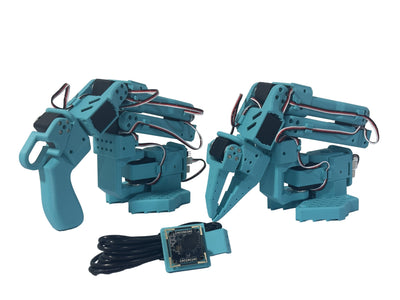
Hiwonder miniAuto Pro ESP32 Mecanum Robot Car Kit — AI Module & 2DOF Arm Options
Hiwonder miniAuto Pro ESP32 Mecanum Robot Car Kit — AI Module & 2DOF Arm Options
Hiwonder
Não foi possível carregar a disponibilidade de retirada


Overview
The Hiwonder miniAuto Pro is an ESP32 programmable robot car for learning Mecanum-wheel motion, sensor feedback and robotics coding. Four encoder motors provide forward, sideways, diagonal and rotational movement. Choose Starter for mobile robotics, Standard for WonderLLM vision and voice projects, or Ultimate for the AI module plus a 2DOF metal robotic arm. Program with Scratch, Arduino or MicroPython as your projects develop.
Choose Your Kit
| Feature | Starter Kit | Standard Kit | Ultimate Kit |
|---|---|---|---|
| App / PC serial / PS3 control | Yes | Yes | Yes |
| Ultrasonic ranging and obstacle avoidance | Yes | Yes | Yes |
| WonderLLM module and real-time Wi-Fi video | Not included | Included | Included |
| Offline AI vision and voice interaction | No WonderLLM module | Supported | Supported |
| Online large-model interaction and ESP-Claw | No WonderLLM module | Supported with setup | Supported with setup |
| 2DOF robotic arm, app pick-and-place and AI transport | Not included | Not included | Included |
The AI camera, touchscreen, microphones and speaker belong to the WonderLLM module supplied with Standard and Ultimate. The robotic arm and gripper are supplied with Ultimate. Full-feature demonstration photographs show the Ultimate configuration; choose the corresponding kit for those capabilities. The wireless control glove is sold separately; a PS3 controller is not listed in the kit contents.
Features
- Metal-frame Mecanum chassis with four HY3722-130 encoder motors and real-time speed feedback for controlled turns, fixed-distance travel and path experiments.
- RGB ultrasonic module, four-channel line follower and expansion-board IMU for ranging, obstacle avoidance, line tracking, intersection detection and sensor fusion.
- ESP32 UNO main board with Wi-Fi and Bluetooth, paired with an expansion board for motor, servo and sensor connections.
- Standard and Ultimate add the WonderLLM ESP32-P4 + ESP32-C5 dual-chip module, 2MP camera, capacitive touchscreen and integrated audio.
- Ultimate adds a metal two-axis arm with anti-stall servos, up to 45 mm gripper height adjustment and up to 147 mm opening for pick-and-place exercises.
AI Vision, Voice and ESP-Claw
On Standard and Ultimate, suitable firmware runs vision functions locally: color recognition and target tracking, visual line following, face, gesture, pedestrian and pet detection, skeleton tracking, QR code and AprilTag recognition, and YOLO11n object detection. Wi-Fi video streaming provides a live view for remote experiments. Grasping functions additionally require the Ultimate arm.
The WonderLLM module integrates with the XiaoZhi AI platform for online text, voice and vision interaction. Supported service integrations include Qwen, DeepSeek and Doubao; ESP-Claw also offers model/API configuration for compatible GPT, Claude, Gemini, Kimi and MiniMax endpoints. Online model requests require network access and the relevant service/API setup. They are separate from locally running vision algorithms and saved robot actions.
ESP-Claw supports multi-step voice or text task breakdown, PC/app interaction, Telegram and WeChat integration, custom tool binding and MCP service expansion. Verified generated actions can be saved as local Lua rules for later execution without repeating a model request. Local memory supports saved preferences and frequent commands. Personality, voice, behavior and wake words can be configured, with over 30 dialogue languages available through the supported voice platform.
Projects include scene description, distance announcements from ultrasonic data, voice-command navigation and combined visual/voice interactions. Ultimate adds object grasping, color sorting, line-following transport and area-based transport exercises. Available actions depend on the installed hardware, firmware and configured services.
Specifications
Robot and Kit Dimensions
| Product | miniAuto Pro smart robot car |
|---|---|
| Frame | Metal |
| Controller | ESP32 |
| Communication / software | Bluetooth; PC visual software and Android/iOS app; Wi-Fi functions with compatible hardware/firmware |
| Control | App, PC serial and PS3 control support; optional Bluetooth 4.0 IMU gesture glove sold separately |
| Overall dimensions | 299 × 164 × 150 mm, full arm-equipped reference configuration |
| Kit body weights | Starter 0.692 kg; Standard 0.749 kg; Ultimate 0.830 kg |
| Kit package weights | Starter 1.13 kg; Standard 1.20 kg; Ultimate 1.29 kg |
| Package dimensions | 376 × 246 × 72 mm |
| Motor model / quantity | HY3722-130 encoder motor ×4 |
| Battery | 7.4 V nominal, 2000 mAh, 3C lithium battery |
| Camera | 2MP, Standard and Ultimate |
| Robotic arm / servos | 2DOF; HPD-0127 + LFD-01, Ultimate only |
| Dimensional drawing references | 164 mm width; 150 mm overall height; 299 mm overall length; 30 mm and 65 mm front references; 64 mm, 50 mm and 31 mm side references; gripper span up to 147 mm |
Product and package masses are kit reference values, separate from the store’s shipping-weight settings. The full arm-equipped dimensions do not describe an identical assembled shape for every kit.
ESP32 UNO Main Board
| Core module | ESP32-32D |
|---|---|
| Clock / USB-to-serial | 240 MHz; CH340C |
| Memory | 520 KB SRAM; 448 KB built-in ROM |
| External flash options | 4 MB / 8 MB / 16 MB board configurations |
| I/O pins | 24 |
| Wireless | Wi-Fi and Bluetooth dual mode |
| Operating / input voltage | 3.3 V logic; 6–12 VDC input |
| DC outputs | 5 V / 2 A or 3.3 V / 1 A |
| Download connector | USB Type-C |
| Board dimensions | 68.9 × 53 mm |
| Board interfaces and controls | Digital I/O, analog inputs, serial communication, I2C and expansion ports; reset button, LED indicator, DC power port and enhanced power module |
ESP32 UNO Expansion Board
| Power input | 6–12 VDC |
|---|---|
| Encoder motor ports | 4 channels |
| Serial bus servo ports | 2 channels |
| PWM servo ports | 4 channels |
| LiDAR port | 1 channel |
| Expansion / GPIO ports | 4 expansion ports; 2 GPIO ports |
| I2C ports | 4 channels |
| Serial communication | 1 port |
| Controls and sensors | 1 LED indicator; 1 buzzer; 1 power switch; onboard IMU |
| Dimensions / mass | 68.5 × 53 mm; 28.5 g |
The main ESP32 performs application processing while the expansion-board ARM controller handles underlying servo scheduling. PWM, buzzer and sensor interfaces support custom projects; a LiDAR connection does not mean a LiDAR unit is included.
WonderLLM AI Module — Standard and Ultimate
| Chip architecture | ESP32-P4 + ESP32-C5 |
|---|---|
| P4 clock / C5 radio | 400 MHz P4; dual-band Wi-Fi 6 C5 |
| Camera / field of view | 2MP; 123° |
| Video formats | 1920 × 1080 MJPG; 640 × 480 YUYV |
| Display | 2.0-inch LCD capacitive touchscreen |
| Audio chip / processing | CI1302; neural-network voice processor |
| Audio and buttons | Microphones, speaker, mode-switch button and wake button |
| Voice wake-up | Configurable wake word |
| Voice recognition distance | Up to 5 m in quiet settings; 1 m in noisy settings |
| Power input / communication | USB Type-C, 5 VDC; I2C |
| Bluetooth | Bluetooth 6.0 and Bluetooth mesh 1.1 |
| Memory / SPI flash | 768 KB L2MEM; 32 MB PSRAM; SPI flash up to 16 MB |
| Wi-Fi bands | 2.4 GHz and 5 GHz |
| Dimensions / weight | 60 × 22 × 54 mm; 46 g |
Encoder Gear Motors
| Detailed motor designation | HY3722-130-48-H encoder motor |
|---|---|
| Operating / nominal voltage | 6–8.4 VDC / 6 VDC |
| No-load speed / current | 273 rpm ±10% / 0.15 A |
| Reduction ratio | 1:45 |
| Stall current | 0.92 A |
| Rated torque | 0.32 kg·cm |
| Connection | 6-pin cable |
| Magnetic ring pulses / revolution | 3 |
| Wheel pulses / revolution | 144 single-phase count; 576 at 4× frequency count |
| Dimensions / mass | 80 × 26.8 × 19.2 mm; 34 g |
Arm Servos — Ultimate Kit
| Parameter | HPD-0127 | LFD-01 |
|---|---|---|
| Speed | 0.05 s/60° at 7.4 V | 0.11 s/60° at 6 V |
| Stall torque | 1.8 kg·cm at 7.4 V | 1.4 kg·cm at 6 V |
| Stall protection | Gear clutch | Power-off protection after 5 s |
| Rotation range | 0–280° | 0–180° |
| Control | PWM | PWM |
Battery and Charger
| Battery type | Lithium battery using 18650 cells |
|---|---|
| Capacity / discharge rate | 2000 mAh / 3C |
| Voltage | 7.4 V nominal; 8.4 V fully charged |
| Dimensions | 68.5 × 36.5 × 18 mm |
| Connections | DC5.5 × 2.5 female / DC5.5 × 2.5 right-angle male |
| Protection board | Overcharge, overdischarge and short-circuit protection |
| Cycle reference | More than 300 charge cycles |
| Included charger | 8.4 V, 2 A; DC5.5 × 2.5 connector |
Programming and Learning
Start with Scratch drag-and-drop blocks, use the Arduino-compatible toolchain for commented source-code projects, or switch supported graphical programs to MicroPython. Open-source resources include controller schematics, robot source code, IGS-format 3D reference files and development tools.
Core robotics
I2C and serial communication; Battery voltage monitoring and alerts; Omnidirectional movement; Speed adjustment; Mecanum wheel kinematics.
Machine vision — Standard and Ultimate
Real-time image transmission; Color recognition and tracking; Visual line tracking; Face recognition; Pet detection; Gesture recognition; Pedestrian detection; QR code and AprilTag recognition; Skeleton tracking; YOLO11n object detection; grasping requires Ultimate.
Human–robot interaction
Voice control with WonderLLM; Ultrasonic obstacle avoidance; Intelligent line following; Intelligent assistant with WonderLLM; Intelligent transport with Ultimate.
Large-model projects — Standard and Ultimate
API integration; Smart chat; Emotion perception; Scene understanding; Image analysis; Encyclopedia Q&A; Posture perception; Smart assistant; Obstacle avoidance; Auto-following; Semantic understanding; Intent recognition; Voice control; Complex command execution; Weather inquiries.
ESP-Claw projects — Standard and Ultimate
Applications; Model selection; API key configuration; Tool binding; Agent interaction; Custom tool calling; Telegram integration; WeChat integration; Status queries; Buzzer control; Obstacle avoidance; Robotic arm control with Ultimate; Action-group calling; Posture perception and setup; Omnidirectional movement; RGB ultrasonic module interaction; Area navigation; intelligent transport with Ultimate.
Applications
- Motion-control lessons: compare wheel speeds, program lateral moves and test star, triangle, square, circular-drift or hexagonal paths.
- Sensor-driven navigation: combine ultrasonic ranging and four-channel line tracking for obstacle-avoidance, crossroads and T-junction exercises.
- AI interaction development: use Standard or Ultimate for local vision recognition, voice interaction and configured online model requests.
- Mobile manipulation: use Ultimate to combine target recognition, navigation and arm control in sorting and small-object transport projects.
What's Included
Included in Every Kit
| miniAuto Pro chassis brackets | 1 set |
|---|---|
| Mecanum wheels | 4 |
| Encoder motors | 4 |
| ESP32 UNO main board and expansion board | 1 each |
| Four-channel line follower sensor | 1 |
| RGB ultrasonic module | 1 |
| USB Type-C cable | 1000 mm |
| Four-pin module cables | 100 mm / 200 mm |
| Six-pin motor cables | 150 mm |
| Lithium battery | 7.4 V, 2000 mAh, 3C |
| Charger | 8.4 V, 2 A, DC5.5 × 2.5 |
| EVA die | 35 mm |
| Screw pack and user manual | Included |
Standard Kit Additions
- WonderLLM AI module.
- Module mounting bracket.
- Additional four-pin module cable, 200 mm.
Ultimate Kit Additions
Includes all Standard Kit additions plus an assembled metal gripper and assembled robotic-arm linkage assembly.
Wireless glove, PS3 controller, computer, smartphone, LiDAR and demonstration props are not listed as included. Use the packing images below to identify the components supplied with each selection.
Videos
FAQ
Which kit includes the AI camera and robotic arm?
Standard and Ultimate include the WonderLLM module with camera, display and audio. Only Ultimate includes the 2DOF arm and gripper; Starter includes neither module nor arm.
Does every AI function work offline?
Local vision runs with suitable firmware on the WonderLLM module. Online large-model dialogue and external service tools require a network connection and the corresponding service/API setup; saved local Lua actions can run without repeating a model request.
Which programming methods are supported?
Scratch, Arduino and MicroPython are supported. PC visual software and an Android/iOS app provide additional control and learning options.
Are the wireless glove and PS3 controller included?
No. The wireless glove is sold separately, and a PS3 controller is not listed in any kit packing list.
Is the battery and charger included?
Every kit includes a 7.4 V 2000 mAh 3C lithium battery and an 8.4 V 2 A charger. The battery reaches 8.4 V when fully charged.
Visual Details
AI-module demonstrations apply to Standard and Ultimate; arm and grasping demonstrations require Ultimate. Screens and props illustrate example projects.